
Your front door opens, and before a single word is spoken, your entryway has already told your guests a story. Is it a warm, welcoming home? A stylish, curated space? Or a chaotic pile of mail, shoes, and forgotten umbrellas? As an interior designer who has styled hundreds of American homes, I can tell you this: nothing shapes that first impression faster than a well-styled entryway console table.

Think of your console table as the opening line of a great novel. It sets the tone, hints at the style of what’s to come, and invites people to keep reading — or in this case, keep walking through your home. Whether you have a grand foyer or a narrow apartment hallway, the right console table styling transforms a purely functional landing spot into a genuine design statement.
In this guide, we’ll walk through everything you need to know about entryway console table decor — from choosing the right table and styling layers to seasonal refreshes and common mistakes to avoid. By the end, you’ll have a foyer that feels intentional, elegant, and unmistakably you.
Why Your Entryway Console Table Deserves Design Attention
Most homeowners underestimate the entryway. It’s often the smallest room in the house, tucked between the front door and the living space, and it gets treated as an afterthought. But interior designers know better: the entryway is prime real estate for making a lasting impact.
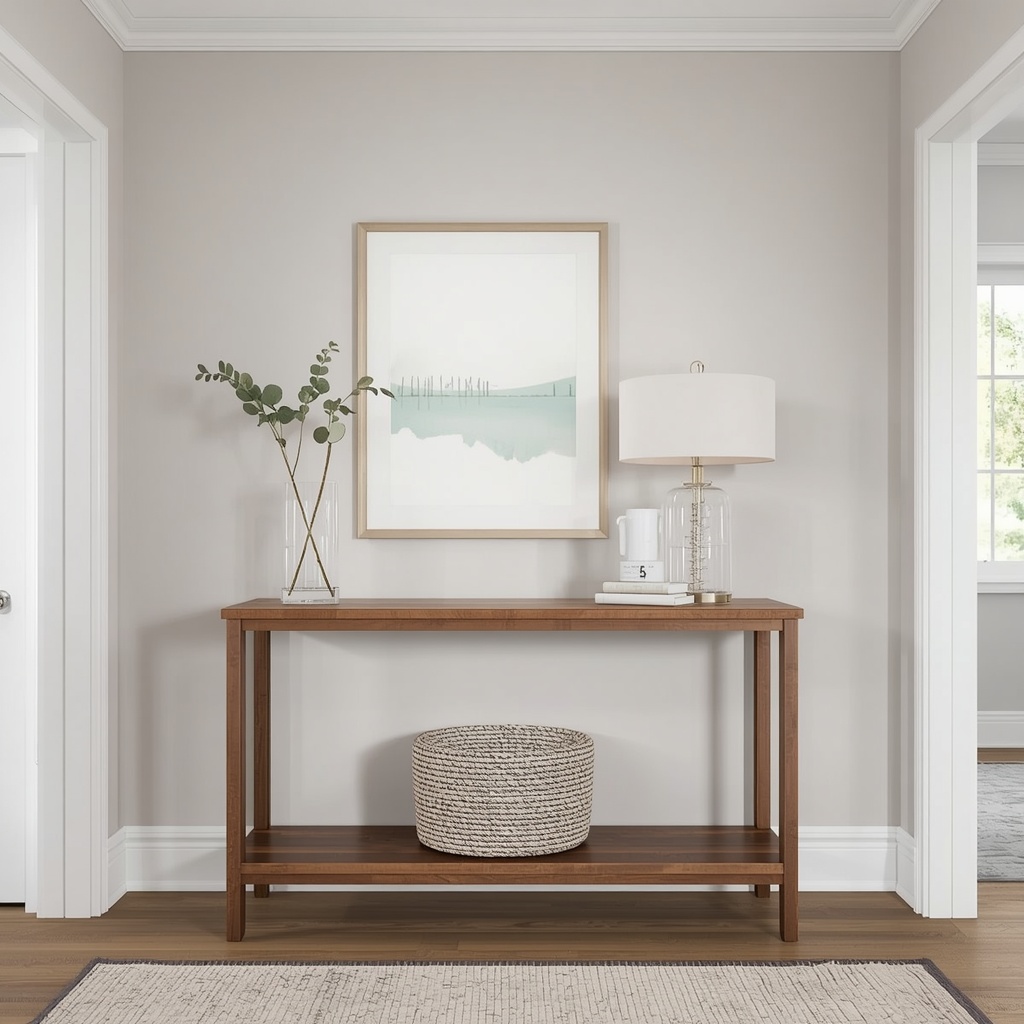
Your entryway console table does double duty. It’s a functional catch-all for keys, mail, and sunglasses, and it’s also a styling showcase that reflects your personal aesthetic. When balanced correctly, it becomes the anchor piece of your home’s foyer decor, setting expectations for the design language used throughout the rest of your home.
“The entryway is the handshake of your home. A cluttered, unstyled console table is a limp handshake — a curated one is a confident, memorable greeting.” — a principle every professional stager lives by.
Beyond aesthetics, a well-designed entryway table styling setup also improves daily function. Studies on organizational psychology consistently show that visual clutter near a home’s entry point increases stress levels for occupants returning from work or errands. A styled, organized console table isn’t just pretty — it’s a small daily ritual of calm.
Choosing the Right Console Table for Your Space
Before you can style anything, you need the right foundation. The table itself matters just as much as what sits on top of it.
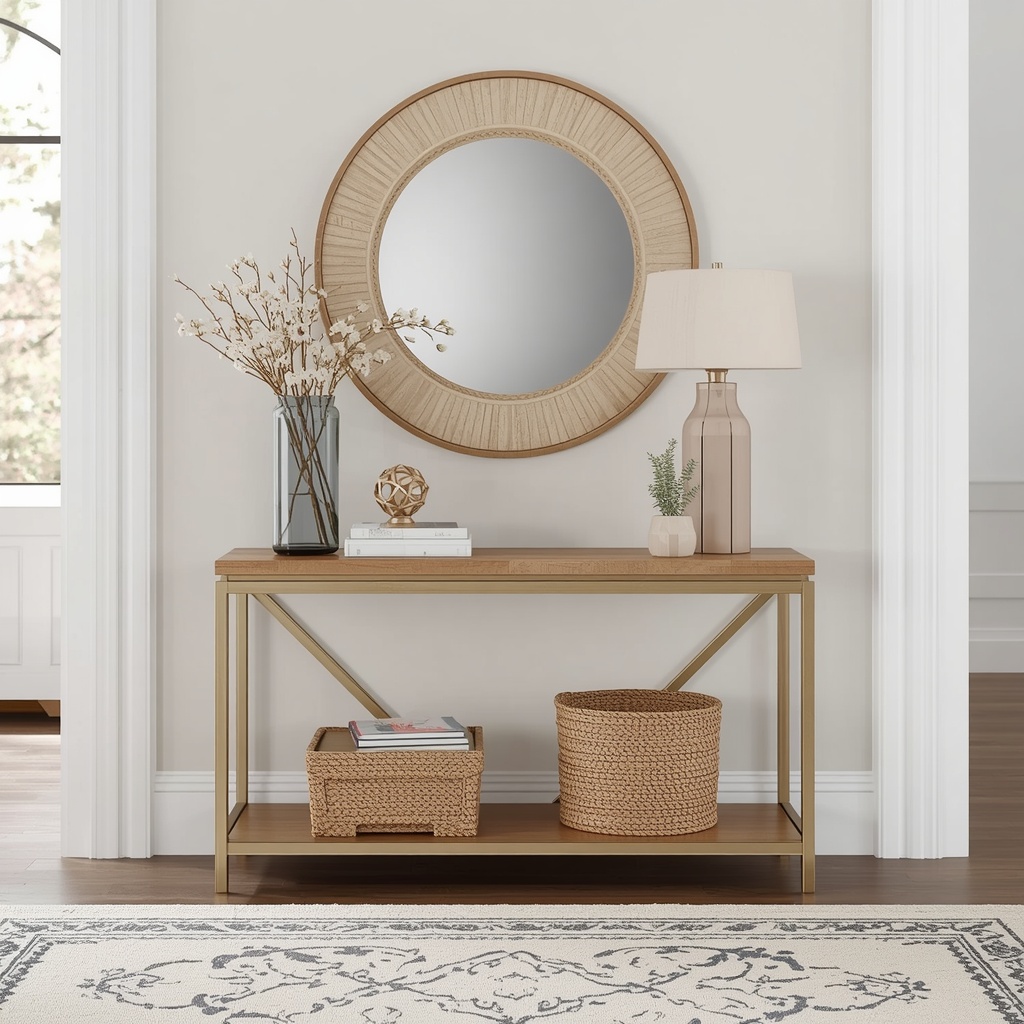
Consider your entryway’s dimensions carefully. A table that’s too large will make a narrow hallway feel cramped, while one that’s too small will look lost in a spacious foyer. As a general styling rule, leave at least 30 to 36 inches of walking clearance in front of the table so it doesn’t obstruct traffic flow.
| Entryway Size | Recommended Table Depth | Recommended Table Length | Style Suggestion |
|---|---|---|---|
| Narrow hallway (under 40″) | 10–14 inches | 30–36 inches | Slim console or wall-mounted shelf |
| Standard foyer (40–60″) | 14–18 inches | 36–48 inches | Classic console table |
| Grand entryway (60″+) | 18–22 inches | 48–72 inches | Statement table with storage |
| Apartment entry/mudroom | 8–12 inches | 24–30 inches | Floating shelf or slim ledge |
Material and finish also matter for cohesive entryway decor. A weathered wood console suits a farmhouse or coastal aesthetic, while a marble-top or brass-accented piece leans more transitional or glam. Choose a finish that echoes at least one other material already present in your home — flooring, staircase railings, or door hardware are great cues to follow.
The Art of Layering: Building Your Console Table Vignette
Professional stylists rely on a tried-and-true layering method when arranging any surface, and the entryway console table is no exception. The goal is visual balance: a mix of heights, textures, and negative space that feels curated rather than cluttered.
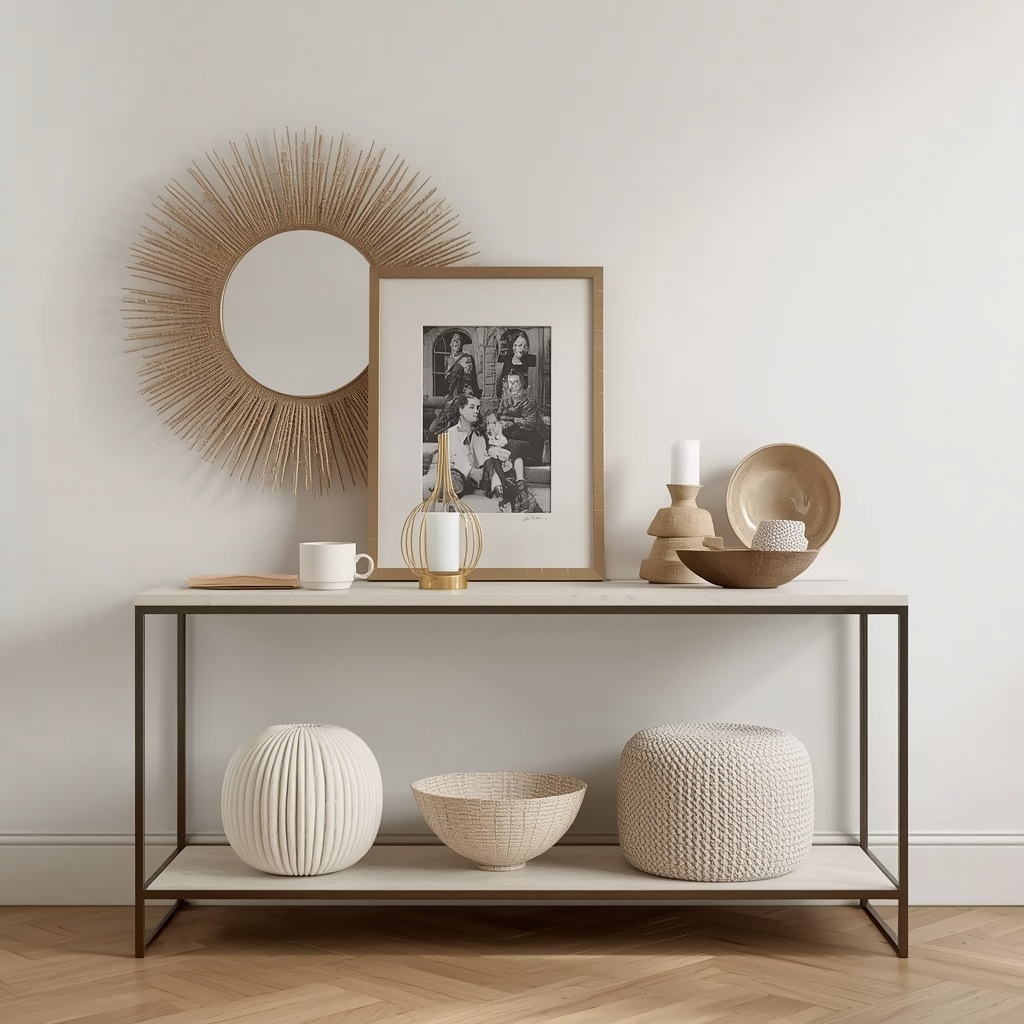
Here’s the foundational styling formula I use with nearly every client:
- Anchor piece — a large lamp, mirror, or piece of art placed above or beside the table
- Height element — a tall vase, sculptural object, or stack of books
- Organic texture — fresh or faux greenery, a woven basket, or a ceramic bowl
- Functional tray — a catchall for keys, mail, or a small dish for jewelry
- Personal touch — a framed photo, candle, or meaningful object that reflects your story
Working in odd-numbered groupings (three or five items) rather than symmetrical pairs almost always looks more natural and dynamic. Vary the heights dramatically — a tall lamp next to a low bowl creates visual rhythm that a flat, uniform arrangement never achieves.
Pro Tip: Before finalizing your arrangement, take a photo of it on your phone. Our eyes tend to forgive small imbalances in person, but a photograph flattens the scene and instantly reveals if one side feels heavier or emptier than the other. Adjust until the photo itself looks magazine-ready.
Layer by Layer: A Sample Styling Breakdown
To make this actionable, here’s how I’d style a standard 40-inch console table from left to right, blending form and function.
| Zone | Item | Purpose | Height |
|---|---|---|---|
| Left third | Table lamp or sculptural candle | Ambient light + anchor | Tall |
| Left third | Small stack of coffee table books | Texture + visual base | Medium |
| Center | Mirror or framed art above | Reflects light, adds depth | Wall-mounted |
| Center | Ceramic vase with branches or dried florals | Organic softness | Tall |
| Right third | Woven tray with keys, sunglasses catch-all | Everyday function | Low |
| Right third | Small potted plant or bowl | Life and color | Medium |
This side-to-side asymmetry keeps the eye moving without feeling chaotic, which is the hallmark of good foyer decor. Once you’re comfortable with this base layout, you can begin swapping accessories seasonally without disrupting the overall structure.
Mirrors, Lighting, and the Power of Reflection
No entryway console table styling guide is complete without addressing what goes above the table. A mirror hung directly over your console does more than check your outfit before you leave the house — it visually doubles your space, bounces natural light deeper into the home, and creates a professional, finished look.
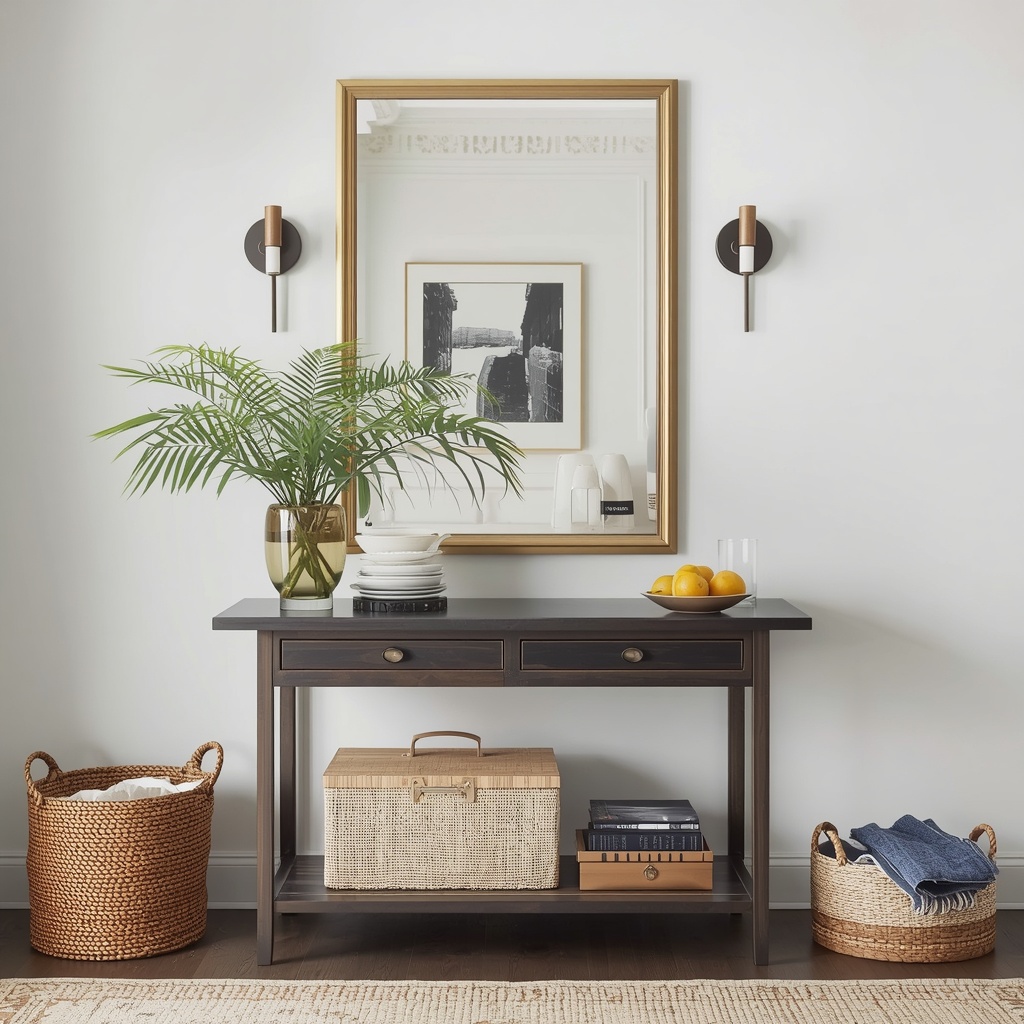
Choose a mirror that’s roughly two-thirds the width of your console table for proportional balance. Round and arched mirrors soften rectangular tables, while an oversized rectangular mirror pairs beautifully with a curved or pedestal-style console for contrast.
Lighting is equally important, especially in entryways that lack abundant natural light. A single table lamp with a warm bulb (2700K–3000K) creates instant coziness the moment guests walk in. If your entryway console sits beneath a hardwired sconce or pendant, layering that overhead light with a lamp on the table creates dimension that flat ceiling lighting alone can’t achieve.
According to design research published by the American Society of Interior Designers, layered lighting is consistently rated among the top factors influencing a room’s perceived warmth and hospitality — and the entryway is often the first room where guests notice it.
Seasonal Styling: Keeping Your Entryway Fresh Year-Round
One of the joys of console table decor is how easily it adapts to the seasons without requiring a full redesign. Because your base layout (lamp, mirror, tray, greenery) stays consistent, you only need to swap smaller accent pieces to keep things feeling current.
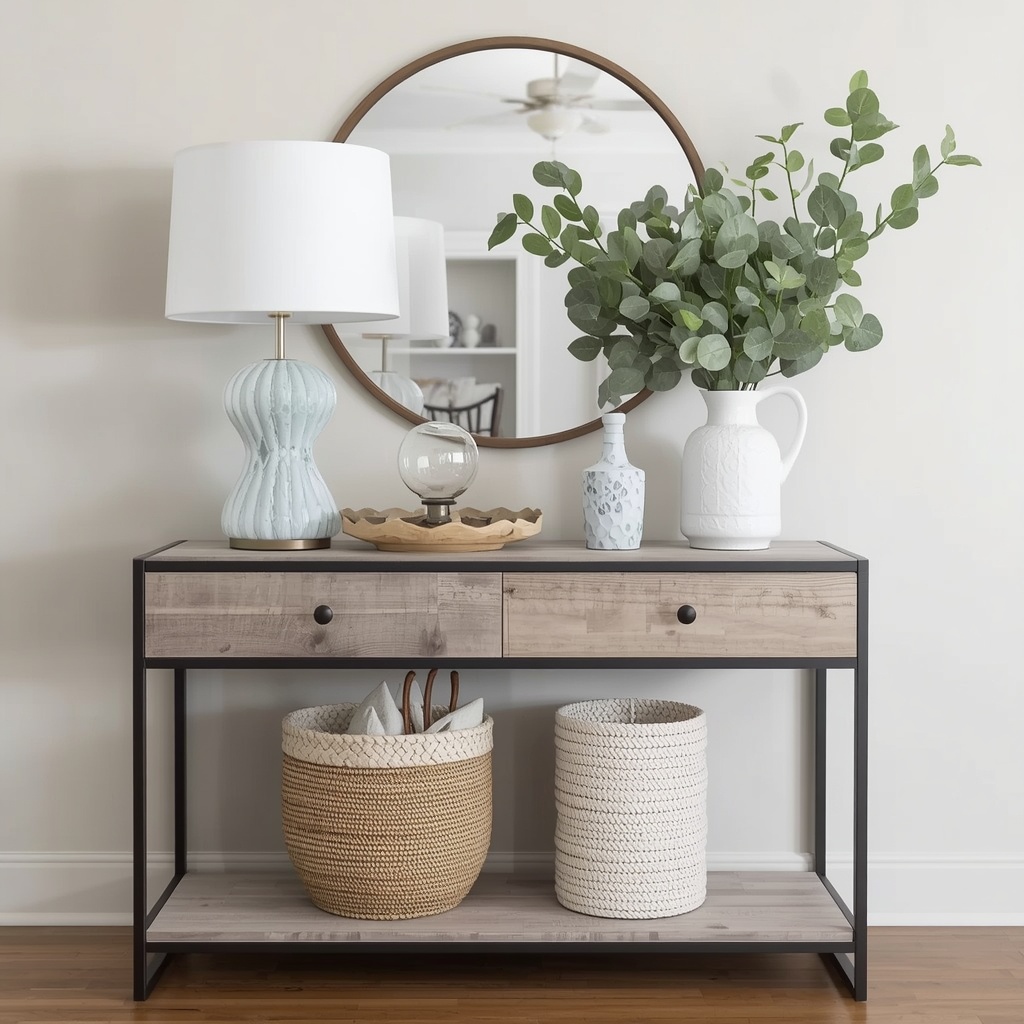
Consider these seasonal refresh ideas:
- Fall — swap fresh flowers for dried wheat stems, pumpkins in muted tones, or a stack of amber-hued books
- Winter/Holiday — add a garland along the table edge, pillar candles, and metallic accents like brass or silver
- Spring — introduce fresh tulips or ranunculus, pastel ceramics, and lighter linen table runners
- Summer — lean into woven textures, citrus in glass bowls, and breezy, coastal-inspired greenery
Rotating these small details keeps your entryway feeling alive and considered throughout the year, which is exactly what makes a home feel lived-in rather than staged once and forgotten.
Common Entryway Console Table Mistakes to Avoid
Even well-intentioned homeowners fall into a few predictable traps when styling their entry table. Here are the most common ones I see in client homes, along with quick fixes.
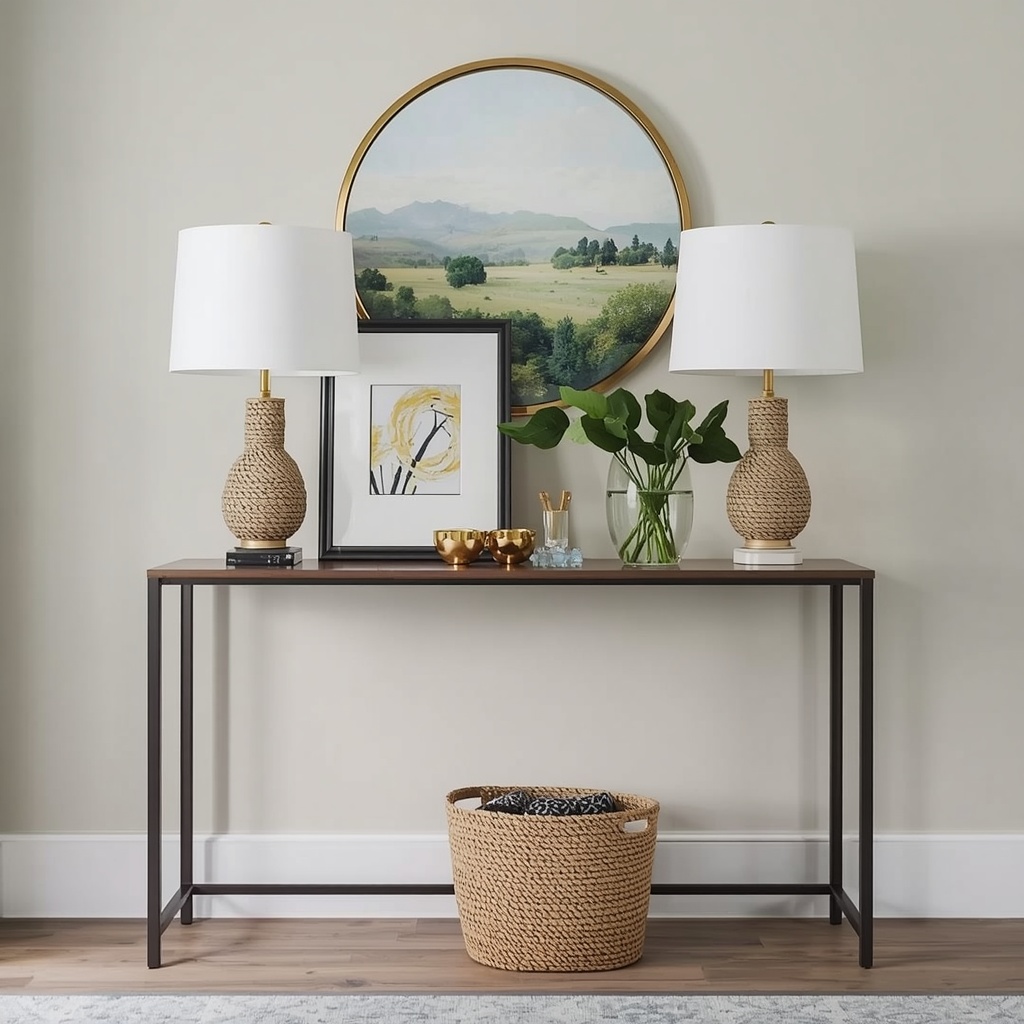
- Overcrowding the surface — if you can’t see the tabletop material itself in a few spots, you likely have too many items competing for attention
- Ignoring scale — tiny accessories on a large table look scattered; oversized pieces on a small table look overwhelming
- Skipping function entirely — a beautiful table that offers no landing spot for keys or mail quickly becomes cluttered with random daily items
- Matching everything too perfectly — a table styled with items all the same color, material, or era can feel sterile rather than inviting
- Forgetting the “walk-by” test — style your table, then walk past it at a normal pace; if nothing catches your eye, it needs more visual interest
Avoiding these missteps is often less about adding more and more about editing thoughtfully — a principle that applies to interior design far beyond just the entryway.
Budget-Friendly Styling Tips
You don’t need a designer budget to achieve a designer look. Small, intentional swaps make a bigger visual impact than expensive, mismatched pieces.
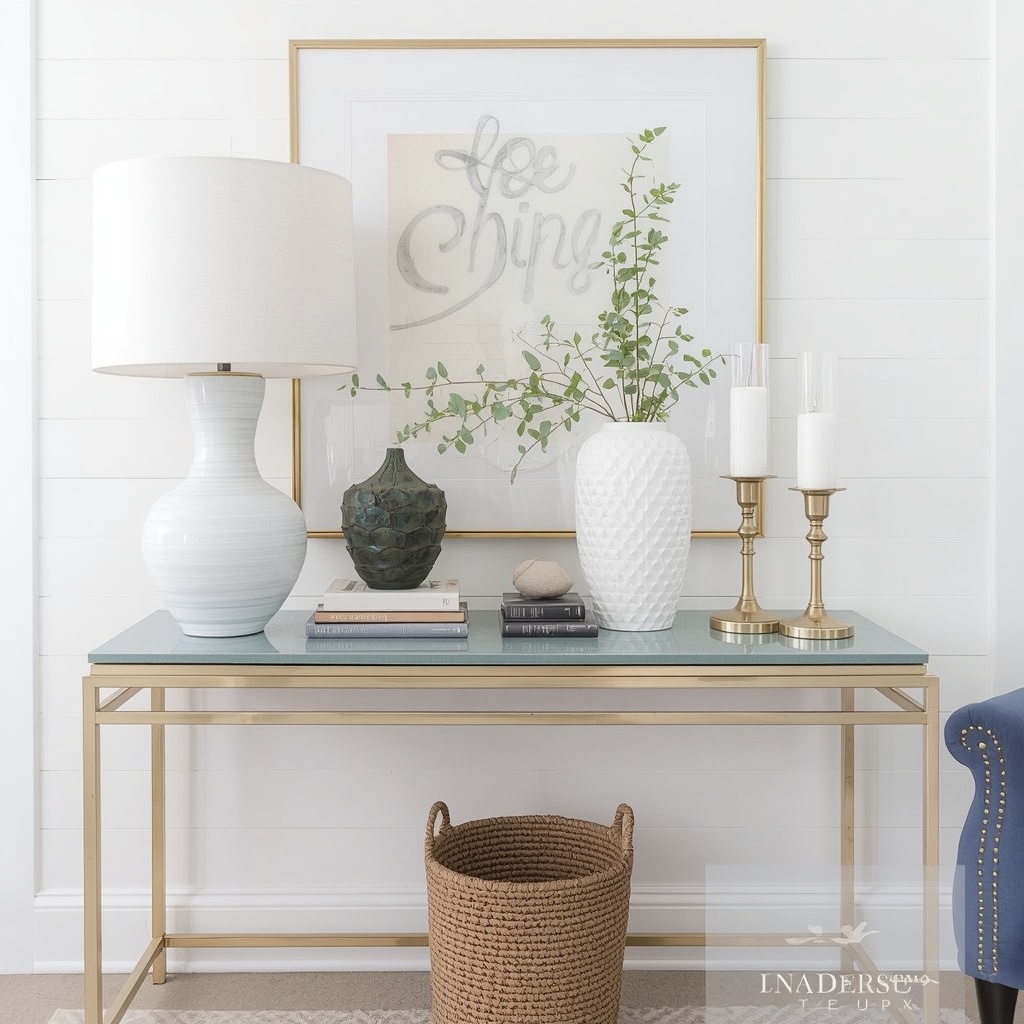
Thrifted brass candlesticks, a secondhand woven basket, or a $20 stems-and-vase combination from a local grocery store can elevate a console table just as effectively as pricier decor. Focus your spending on the one or two “anchor” pieces — the lamp or the mirror — since those carry the most visual weight, and save on smaller accent items that can be swapped seasonally without guilt.
Pro Tip: Shop your own home before you shop a store. Pull a vase from your kitchen, a tray from your bathroom, or a stack of books from your shelf and test them on the console first. You’ll often discover a beautiful new combination hiding in plain sight elsewhere in your house.
Final Thoughts: Style It Like You Mean It
Your entryway console table is more than a landing pad for mail — it’s the visual handshake that welcomes everyone into your home, including you, every single day. A thoughtfully styled entry table blends beauty with practicality, reflecting your personal style while keeping daily essentials within easy reach.
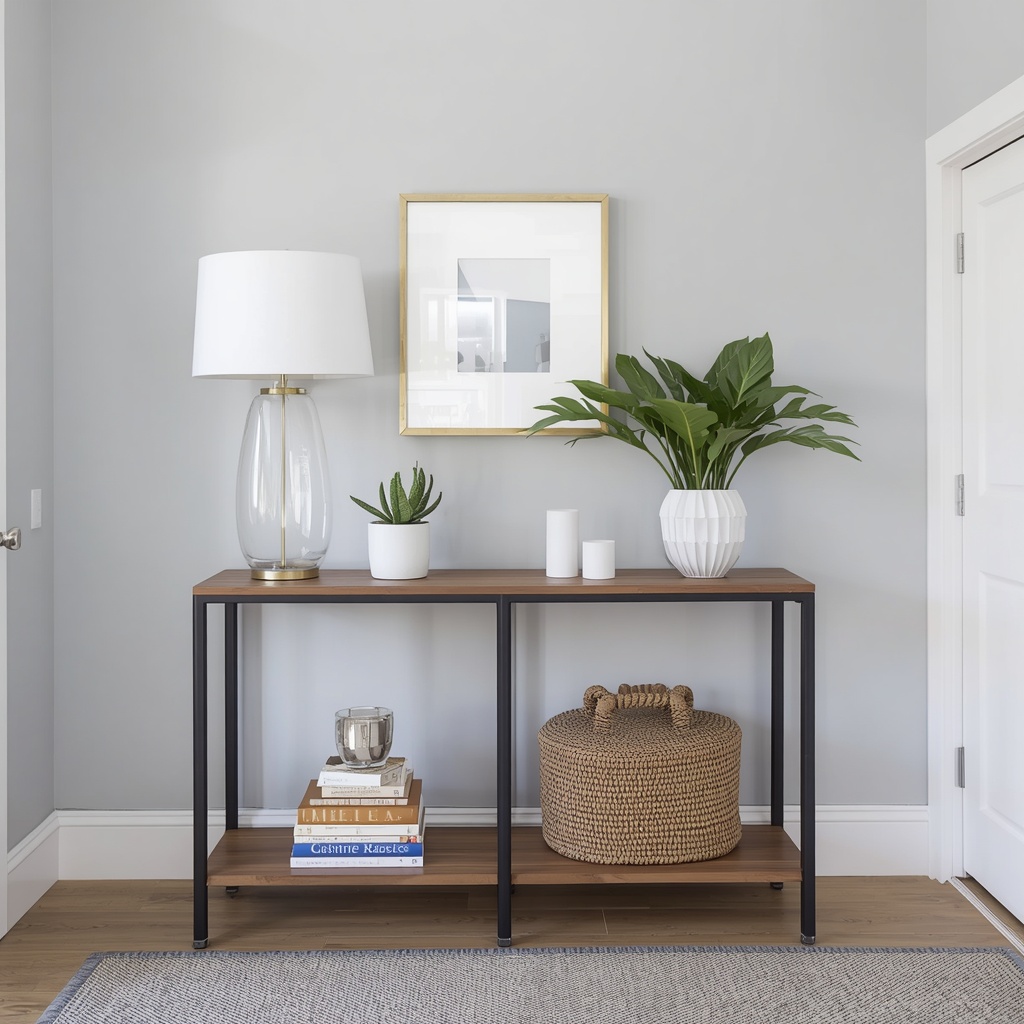
Start with the right-sized table, layer in varying heights and textures, add a mirror and warm lighting, and don’t be afraid to refresh small details with the seasons. The goal isn’t perfection — it’s a space that feels warm, functional, and unmistakably yours the moment the front door opens.
Small changes, thoughtfully made, are often what separate a house from a home — and your entryway is the very first place that story gets told.