
Your hallway is the first space guests see — and the last one you leave every morning. Yet narrow hallways are consistently one of the most overlooked, underutilized, and overcrowded spaces in American homes. The good news? With the right design principles, even a slim 36-inch corridor can feel airy, elegant, and intentional.

As an interior designer who has transformed hundreds of tight entryways and corridors across the US, I can tell you this: the biggest mistake homeowners make is treating the hallway as a dumping ground. Hooks piled with coats, side tables stacked with mail, oversized runner rugs — it all adds visual clutter that makes the space feel suffocating. Let’s fix that.
In this guide, I’m sharing my tried-and-true strategies for narrow hallway decorating that balance function, flow, and style — without making your passageway feel like a closet.
· · ·
1. Understand the Psychology of Small Space Design
Before you buy a single piece of furniture or hang anything on the wall, it helps to understand why narrow spaces feel cramped. It almost always comes down to three culprits: visual weight, scale, and light. A hallway cluttered with dark, heavy elements stops the eye constantly, making the brain read the space as smaller than it actually is.
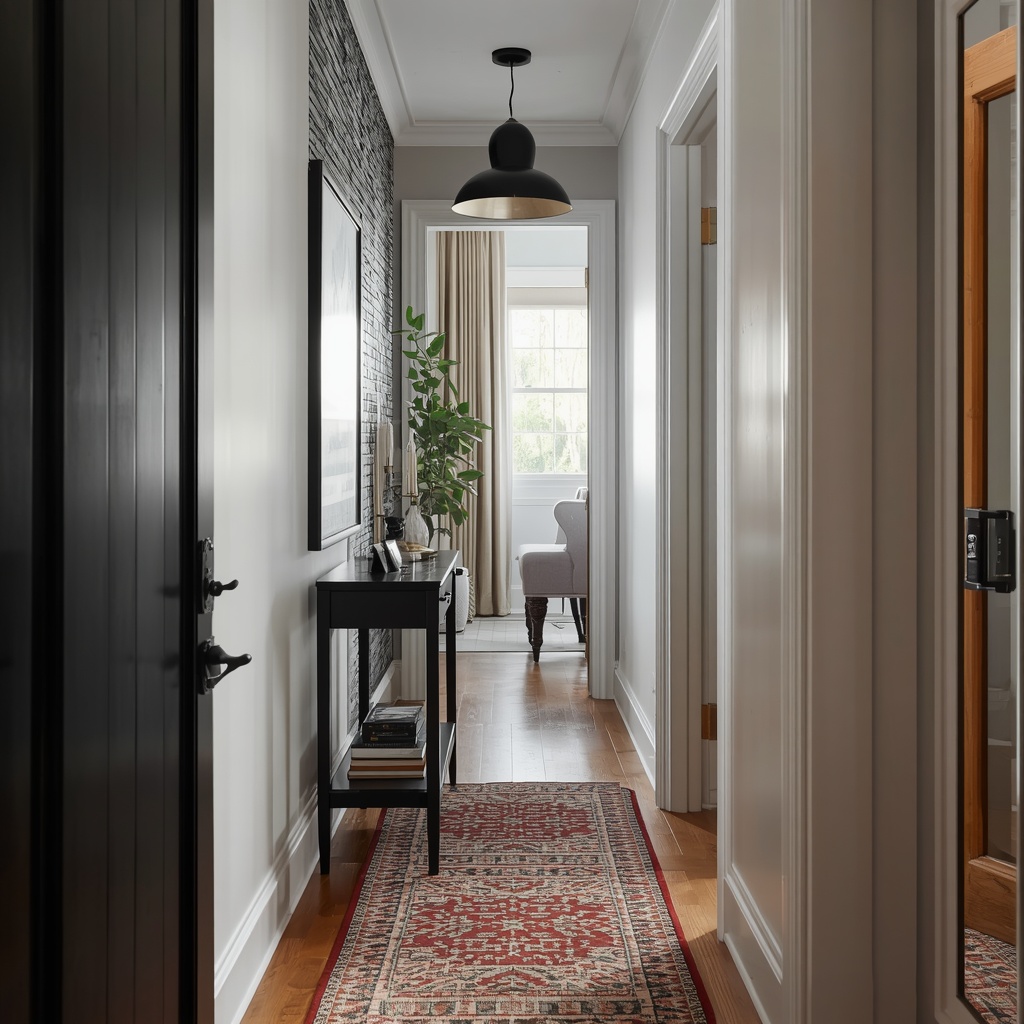
Effective small hallway decorating works with the eye, not against it. When you guide the gaze forward — down the length of the corridor — you create an illusion of expanded depth. This is the foundational principle behind every tip in this article, from furniture choice to color palette to lighting strategy.
“A hallway should feel like an invitation, not an obstacle course.”— Nate Berkus, Interior Designer
2. Choose the Right Paint Colors for a Narrow Hallway
Color is your most affordable and powerful design tool. The right hallway paint colors can visually widen, lengthen, and brighten a tight passage without a single structural change. As a general rule, lighter values reflect more light and make walls feel farther apart.
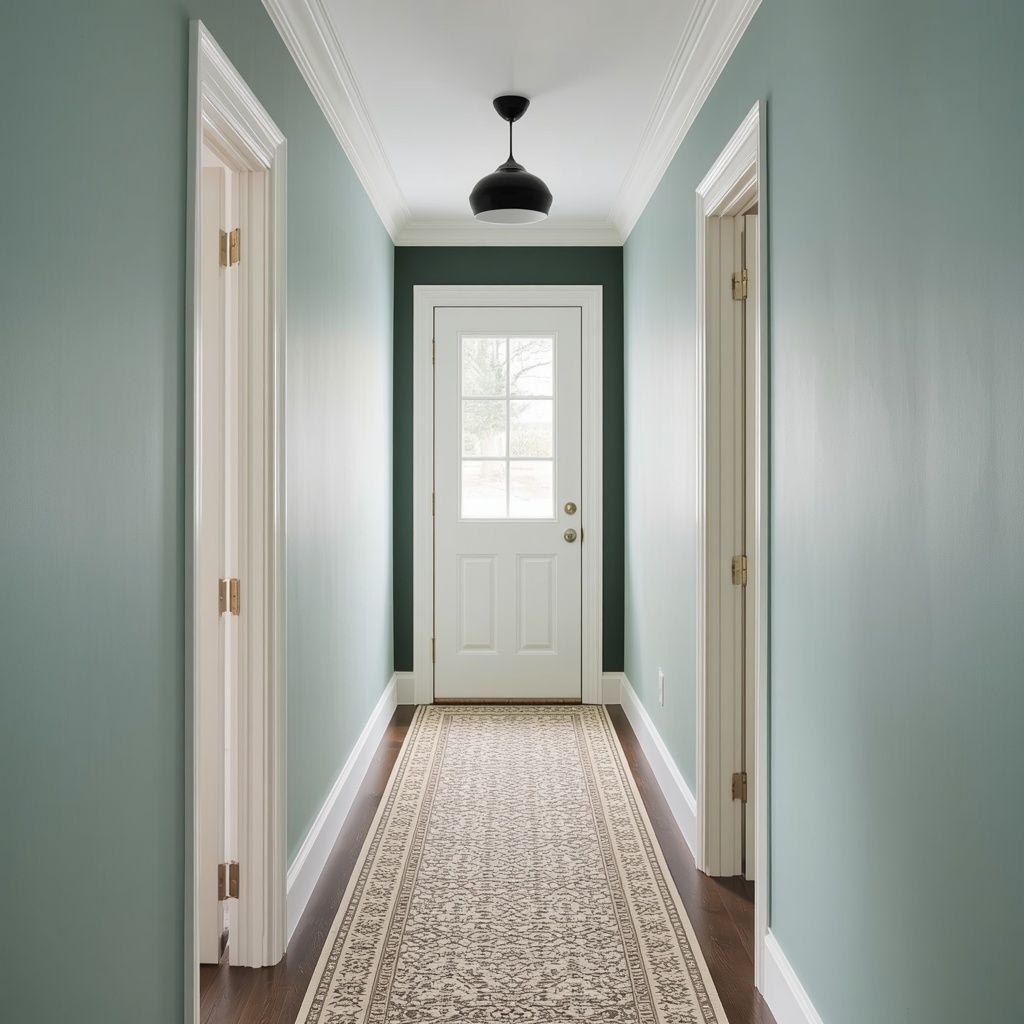
That said, don’t be afraid of darker accent walls at the far end. A deep, saturated tone on the terminal wall — think charcoal, navy, or forest green — creates visual depth and draws the eye forward, making the hallway feel longer. This technique is sometimes called color zoning, and it’s one of my favorite tricks for narrow entryways.
| Color Strategy | Best For | Effect | US Popular Picks |
|---|---|---|---|
| Soft whites & off-whites | Low-light hallways | Reflects light, expands walls | Sherwin-Williams Alabaster, BM White Dove |
| Warm greiges | Traditional & farmhouse homes | Cozy yet open feel | BM Pale Oak, SW Accessible Beige |
| Cool sage greens | Modern & transitional homes | Visually recedes walls | BM Aganthus Green, Farrow & Ball Mizzle |
| Dark accent end wall | Long narrow hallways | Creates depth & drama | SW Inkwell, BM Hale Navy |
💡
Pro Tip
Paint your hallway ceiling the same color as the walls — or one shade lighter. This removes the visual “chopping” effect that a bright white ceiling creates against colored walls, making the corridor feel taller and more cohesive. It’s a small change with a big perceptual impact.
3. Use Mirrors Strategically to Open the Space
If I could recommend just one element for every narrow hallway in America, it would be a well-placed mirror. Mirrors for narrow hallways are a design staple for good reason — they bounce light, double the perceived width, and add a layer of visual sophistication that few other pieces can match.
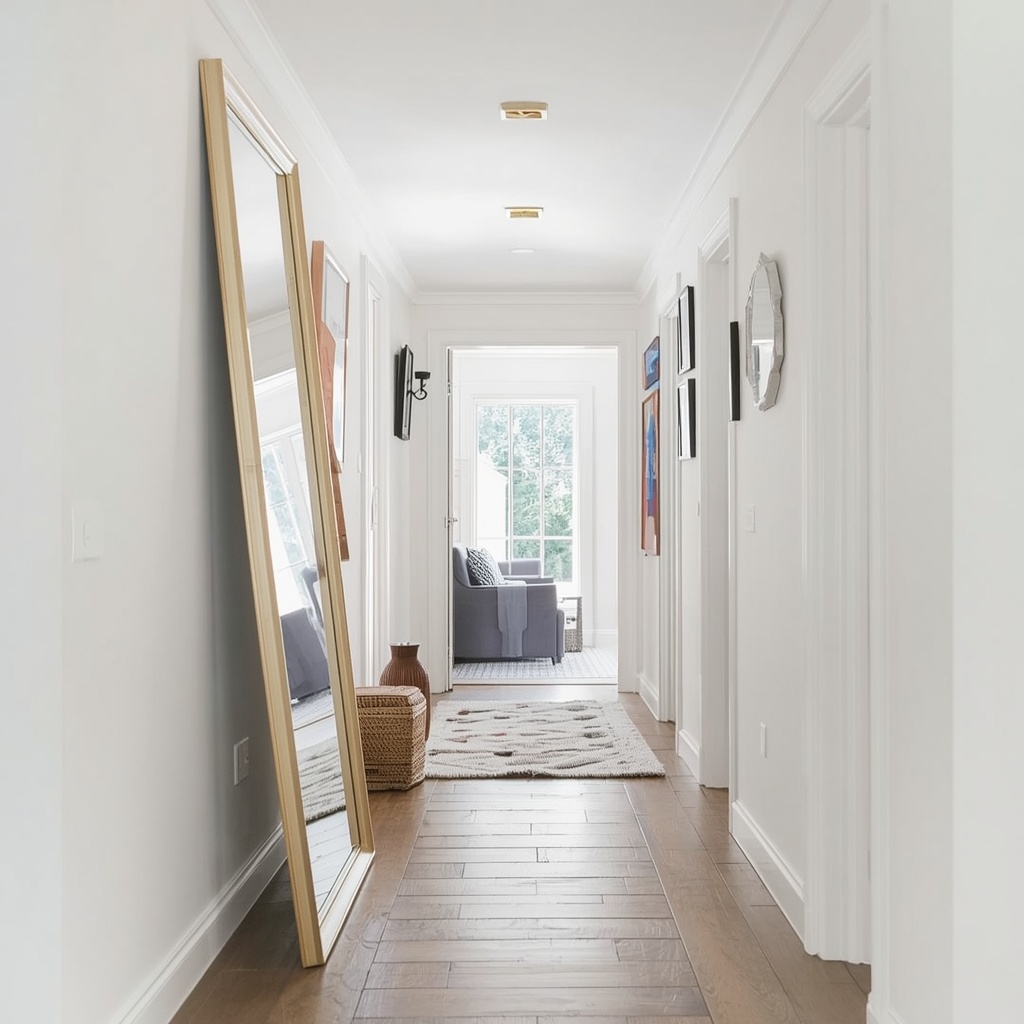
The key word here is strategic. A large, vertically oriented mirror placed on a side wall will visually push that wall away, widening the hallway in the eye. A series of smaller mirrors arranged in a gallery wall can add personality while doing the same work. What you want to avoid is placing mirrors at the end of the hallway facing the entrance — this can create a dizzying, infinite reflection effect that actually increases visual noise.
- Mount a full-length or oversized mirror on one long side wall
- Choose frames in light finishes — brass, white, natural wood
- Position mirrors across from a window to amplify natural light
- Use a leaning mirror to avoid hardware damage in rentals
- Consider a frameless mirror for a sleek, contemporary look
4. Select Slim, Wall-Mounted, and Multi-Functional Furniture
Furniture scale is where most narrow hallway decorating goes wrong. A standard console table is typically 12–15 inches deep — but in a 36-inch hallway, that leaves only 21 inches of clearance, which feels tight and can violate fire egress guidelines. The solution is to think slim, vertical, and wall-mounted.
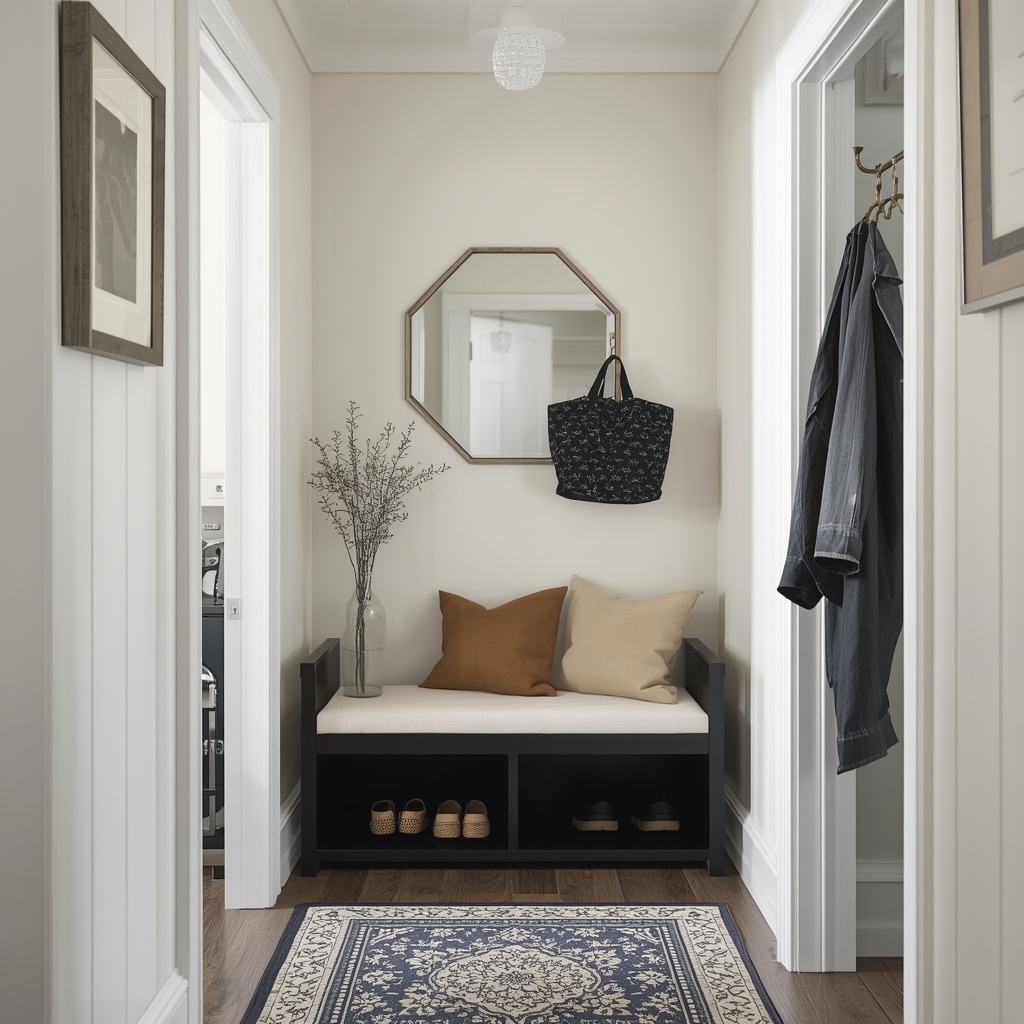
Look for hallway furniture specifically designed for tight spaces: floating shelves, wall-mounted coat racks, shallow console tables under 10 inches deep, and built-in bench storage with a closed base. Multi-functional pieces earn their place by doing double or triple duty — a wall-hung key cabinet that also holds a mirror, or a narrow bench that opens for shoe storage.
🪑
Floating Shelf Console
Just 5–8″ deep. Provides a surface for keys and décor without protruding into the path.
🪝
Wall-Mounted Coat Rack
Keeps coats off the floor and eye-level. Choose styles that fold flat when not in use.
📦
Bench with Hidden Storage
Slim 12″ depth models offer shoe storage and seating without overwhelming the width.
🪞
Mirror Cabinet
Combines mirror, storage, and display in one flush-mounted unit. Zero floor footprint.
5. Layer Lighting to Eliminate Dark Zones
Poor lighting makes narrow hallways feel like tunnels. Adequate, layered hallway lighting is one of the most impactful upgrades you can make — and it’s often the most overlooked. The goal is to eliminate shadowy spots and create a consistent wash of light that makes the entire length of the corridor feel welcoming.
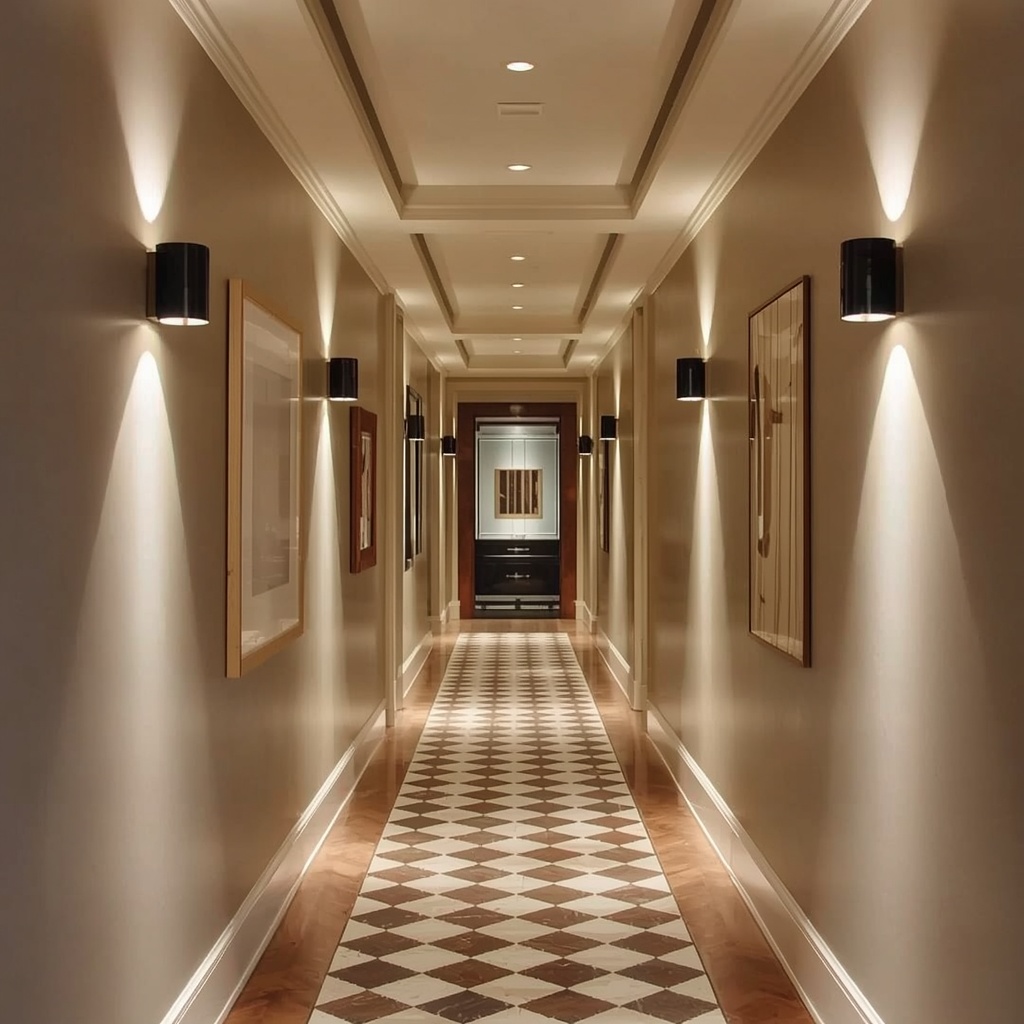
Start with ambient overhead lighting, ideally a series of recessed lights or a flush-mount fixture every 8–10 feet. Layer in wall sconces at eye level (approximately 60–65 inches from the floor) on alternating or opposite walls — these draw the eye along the path and add warmth. If your hallway has artwork or a gallery wall, small picture lights or directional track lighting add drama without bulk.
💡
Pro Tip
Install a dimmer switch in your narrow hallway. Being able to dial down the intensity at night transforms it from a functional pass-through into a warm, atmospheric transition space. LED-compatible dimmers are widely available at Home Depot and Lowe’s for under $25.
6. Choose Rugs That Elongate Rather Than Interrupt
The wrong rug can visually chop a hallway into segments, making it feel shorter and busier. The right hallway runner rug, however, guides the eye from one end to the other and provides warmth, sound absorption, and style — all at once. This is one of the most powerful and affordable design moves in a narrow corridor.
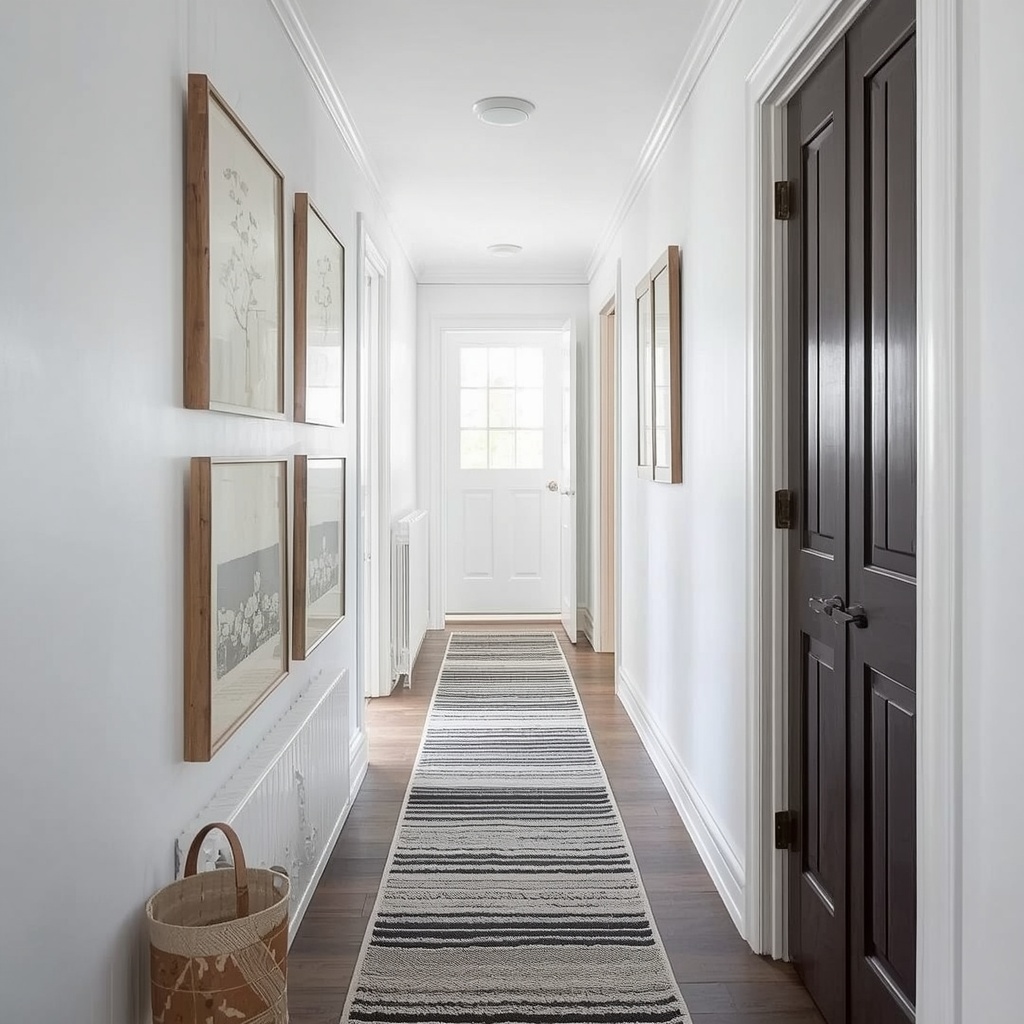
For narrow hallways, always choose a runner that runs as close to the full length of the corridor as possible, leaving just 4–6 inches of floor visible on each side and at each end. Avoid wide runners that butt up against the baseboards — these will emphasize how little floor width there is. In terms of pattern, lengthwise stripes are your best friend: they create a visual train track effect that makes the hallway feel dramatically longer.
| Rug Feature | Do This | Avoid This |
|---|---|---|
| Width | Leave 4–6″ of floor on each side | Wall-to-wall width; too-narrow runners |
| Length | As long as the hallway (minus 6″ each end) | Short rugs that break up the space |
| Pattern | Lengthwise stripes, subtle geometrics | Large medallions, wide crosswise stripes |
| Color | Medium tones; echoes main floor finish | Very dark colors in low-light hallways |
| Pile | Low pile for easy vacuuming & traffic | High pile (shag) — traps shoes, looks bulky |
7. Create Vertical Interest with Wall Décor
When floor space is at a premium, the walls become your canvas. Thoughtful wall décor for narrow hallways shifts visual attention upward and outward, drawing the eye away from the limited width and toward the overall atmosphere of the space. Done right, this transforms a plain corridor into a curated gallery experience.
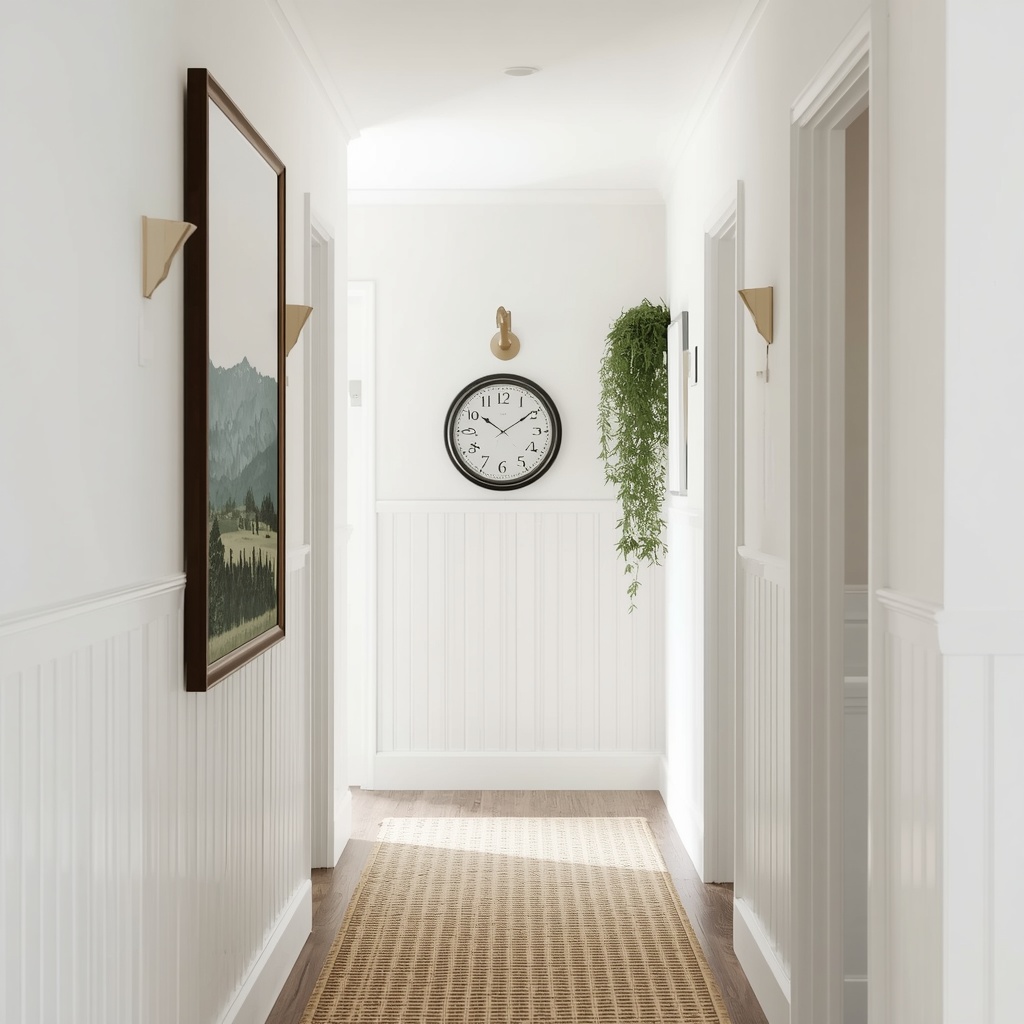
The trick is to keep art and décor proportional to the wall height and spacing. In a tight hallway, oversized statement art on one wall creates a focal moment without cluttering the floor. A vertical arrangement of three to five frames — stacked rather than spread horizontally — emphasizes ceiling height and takes up minimal linear wall space. Always keep the visual centerline of your art at approximately 57–60 inches from the floor, which is standard gallery height and feels most natural to the walking eye.
- Hang a single large-scale botanical or landscape print as an anchor piece
- Create a vertical photo gallery with 3–5 frames in matching finishes
- Use wall-mounted plant brackets with trailing plants for organic texture
- Add a decorative wall clock — functional and beautiful
- Consider wainscoting or board-and-batten paneling for architectural interest without bulk
- Install a wall-mounted shelf display at the end of the hallway as a “landing moment”
💡
Pro Tip
Hang your art slightly higher than the standard 57-inch center rule in narrow hallways — try 62–65 inches. This subtle shift draws the gaze up, emphasizing height over width, and makes the ceiling feel taller. It’s a technique I use in nearly every tight corridor project.
8. Add Texture Without Adding Visual Bulk
One of the most common fears homeowners have about narrow hallways is that adding texture or pattern will make the space feel even smaller. In reality, the right textures add visual richness and warmth without contributing any physical bulk — and that distinction matters enormously in a tight space.
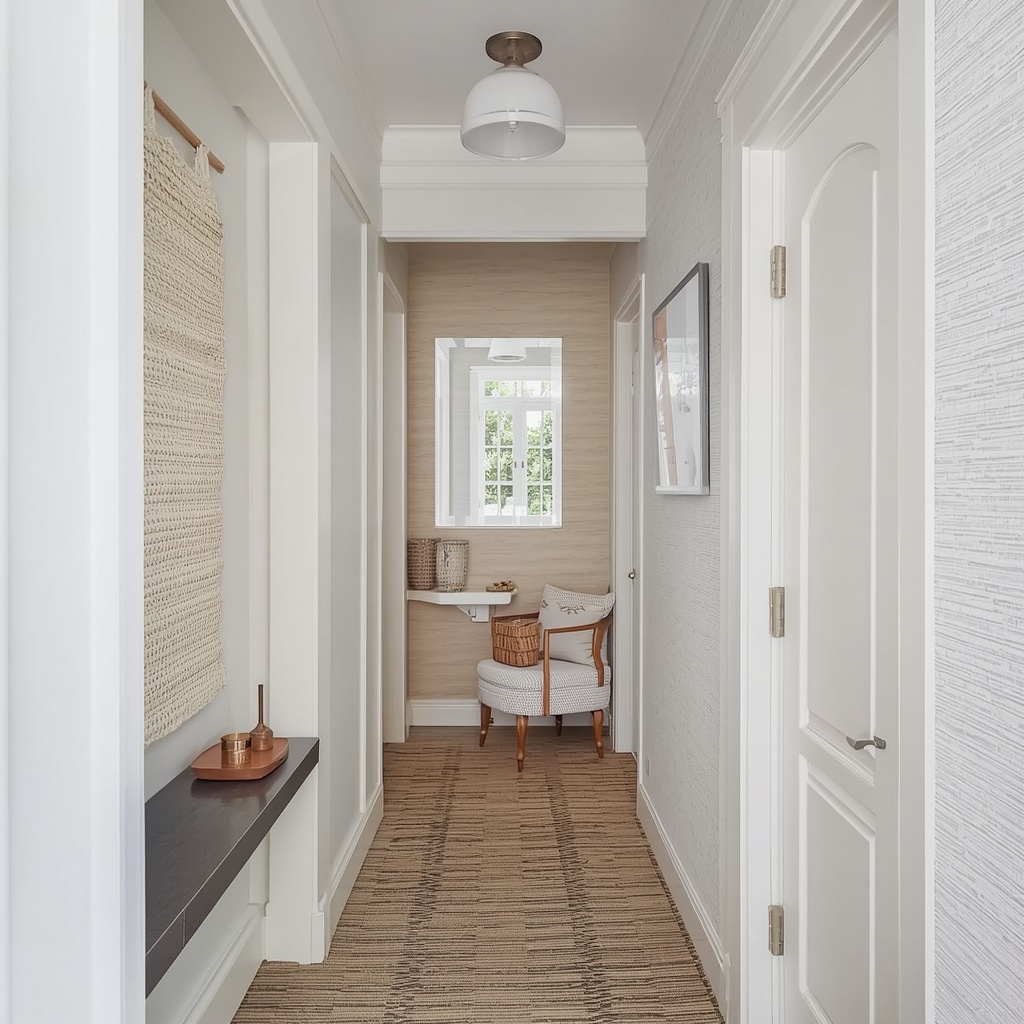
Think tactile, not volumetric. A woven rattan wall hanging, a plaster-textured paint finish, a linen wall panel, or a grasscloth wallpaper adds depth and interest to walls without any protrusion into the walkway. Similarly, textured throw baskets on a floating shelf, a ceramic vase, or a woven tray on a slim console add layers of material richness without crowding the surface. The goal is to engage the senses — something that feels considered and curated, never bare or sterile.
“Texture is the whisper of a room. It says everything without shouting.”— Kelly Wearstler, Interior Designer
9. Declutter and Organize with Intentional Storage
No amount of beautiful décor will overcome a cluttered narrow hallway. Clutter is the single biggest enemy of small space design — it collapses perceived space faster than dark paint, low lighting, or wrong-scale furniture. Functional hallway storage ideas must be baked into the design from day one, not added as an afterthought.
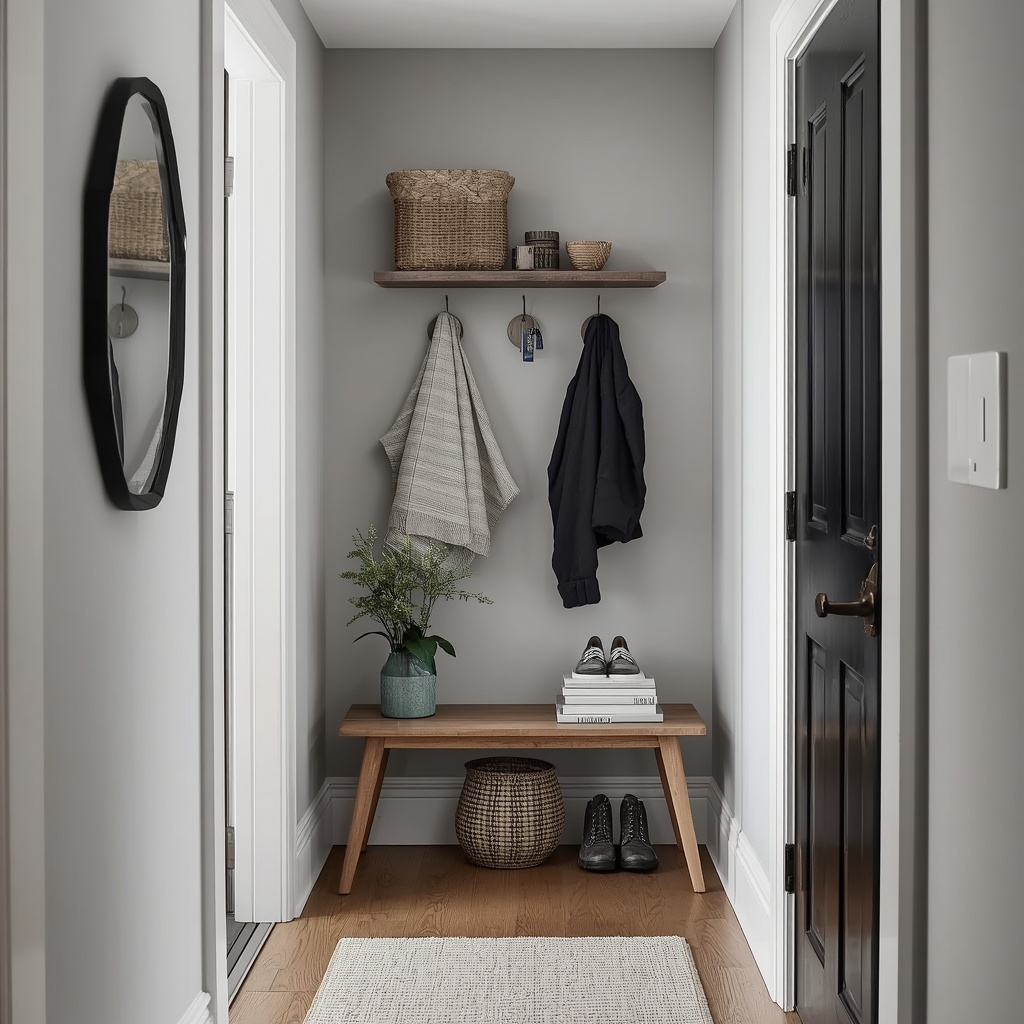
The discipline here is intentionality: every item in the hallway must earn its place. If it doesn’t serve a daily function or deliver genuine aesthetic joy, it has no business being there. A disciplined edit — keeping only the essentials — will do more for your narrow hallway than any single design purchase. Once your “keep” items are identified, find dedicated hidden storage for each one so the visual field stays clean.
- Limit hooks to 3–4 per household member — not one for every coat you own
- Use a closed cabinet or basket for shoes instead of open floor storage
- Assign a designated tray or bowl for keys, mail, and small items
- Go through hallway storage seasonally — remove off-season coats and gear
- Use the back of the hallway door for additional storage with over-door organizers
- Invest in a slim, wall-mounted mail organizer to eliminate paper piles
10. Bring in Nature for Life and Freshness
Plants in narrow hallways are a design move that brings outsized impact for minimal floor investment. A well-chosen plant adds color, organic texture, freshness, and a sense of life to what would otherwise be a purely functional transition space. The key, as always, is scale and placement — no floor-standing fiddle leaf figs in a 36-inch hallway.
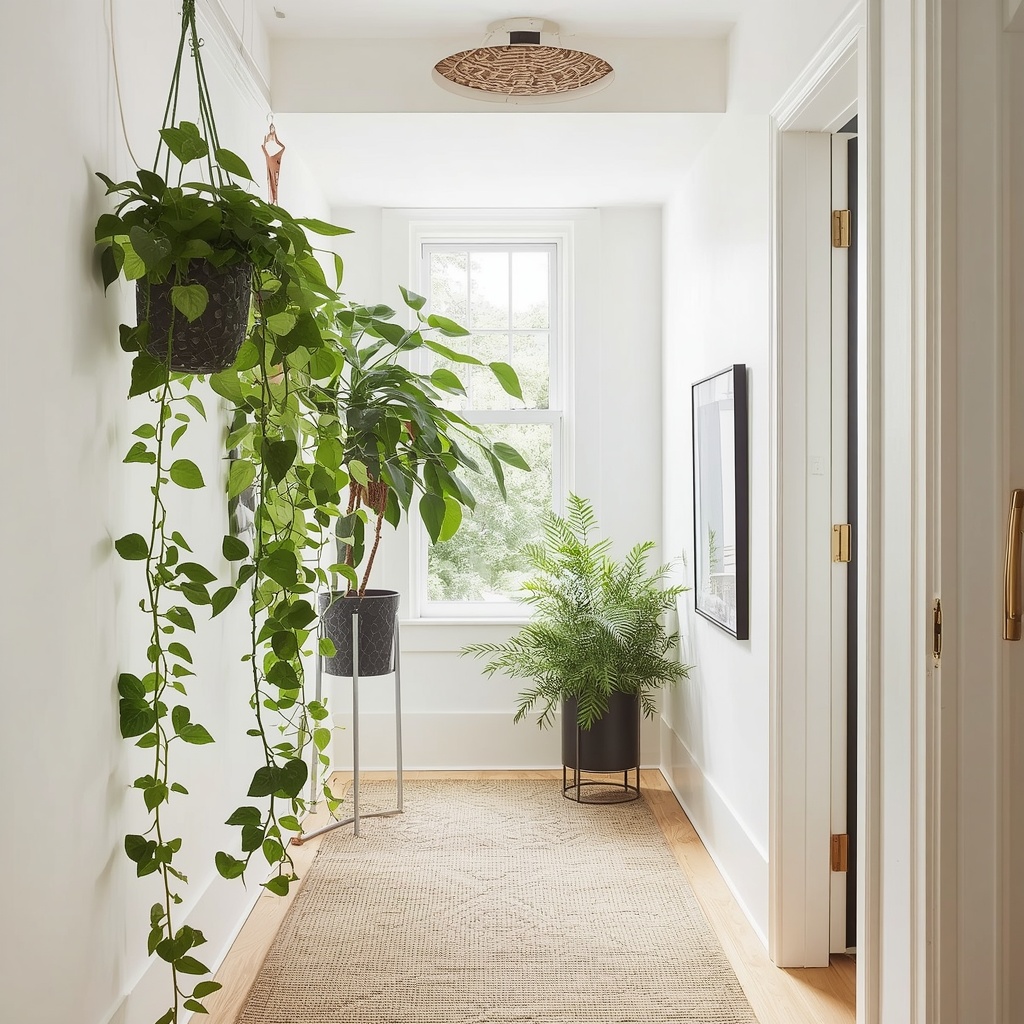
Opt for wall-mounted plant brackets or floating shelf planters that keep greenery at eye level or above. Trailing plants like pothos, string of hearts, or heartleaf philodendron are ideal — they cascade elegantly without taking up horizontal space. If natural light is minimal (as it often is in interior hallways), lean on low-light champions like ZZ plants, snake plants, or cast iron plants. A single, well-placed plant in a beautiful ceramic pot can anchor the entire design of a narrow hallway.
| Plant | Light Needs | Placement | Why It Works |
|---|---|---|---|
| Pothos | Low to medium | Shelf or wall bracket | Trails beautifully, nearly indestructible |
| Snake Plant | Low | Slim corner or shelf | Vertical form maximizes height, not width |
| ZZ Plant | Low | Floating shelf | Glossy, architectural, low maintenance |
| Air Plants (Tillandsia) | Bright indirect | Wall-mounted display | No soil, no pot, zero floor footprint |
| String of Hearts | Medium indirect | High shelf to trail down | Delicate, romantic, takes up no width |
💡
Pro Tip
No natural light in your hallway? Don’t default to plastic. Instead, invest in a high-quality grow light disguised as a stylish track or picture light. Modern LED grow lights emit a warm, pleasant glow that’s indistinguishable from regular lighting — and your real plants will thrive.
· · ·
The Bottom Line: Curate, Don’t Crowd
Decorating a narrow hallway is ultimately an exercise in restraint and intention. Every element should earn its place — visually, functionally, or ideally both. Use light to expand, mirrors to widen, vertical art to add height, and slim furniture to serve without overwhelming. Edit ruthlessly, layer thoughtfully, and let the hallway breathe.
A well-designed narrow hallway doesn’t just look better — it feels better. It sets the tone for the entire home, welcoming you (and your guests) with a sense of calm and care. Start with one change from this list, and let it inspire the rest.