
Kitchen Design Guide
Tumbled Limestone Tiles for Timeless Kitchens
Why America’s most enduring natural stone is having its biggest moment yet — and how to use it beautifully in your home.

Tumbled Lime stone Kitchen Flooring Natural Stone Tile Rustic Kitchen Decor Farmhouse Kitchen Stone Backsplash
If you’ve ever walked into a kitchen and felt an immediate sense of warmth — like the room itself was exhaling — there’s a good chance tumbled limestone was underfoot or lining the walls. As an interior designer who has worked on hundreds of American homes, from Craftsman bungalows in the Pacific Northwest to sprawling Texas farmhouses, I can say with absolute conviction: tumbled limestone tiles are one of the most consistently stunning, enduringly elegant flooring and wall choices you can make for a kitchen.
Unlike trendy materials that look dated within a decade, tumbled limestone carries a natural, worn beauty that only improves with age. The “tumbling” process — where tiles are rolled in large drums to soften sharp edges and create an aged, weathered texture — produces a surface that feels as though it’s been worn smooth by centuries of use. It is old-world craftsmanship meeting modern American kitchen design, and the result is nothing short of breathtaking.
“Natural stone doesn’t just decorate a kitchen — it anchors it. Tumbled limestone, in particular, has this extraordinary ability to make a brand-new kitchen feel like it has always been there.”— Sara Whitfield, Certified Interior Designer
What Exactly Is Tumbled Limestone — And Why Does It Matter?
Limestone is a sedimentary rock composed primarily of calcium carbonate, often formed from ancient marine organisms. What makes tumbled limestone unique is the finishing process: fresh-cut tiles are placed in a rotating drum with water, sand, and abrasive material, gently distressing the surface until it achieves that characteristic soft, matte, slightly uneven texture that designers and homeowners love.

The result is a tile that looks authentically aged — never harsh, never sterile. The tumbled stone texture softens the light beautifully, absorbs kitchen warmth rather than reflecting it harshly, and pairs naturally with virtually every cabinet color and countertop material on the market. From a purely design standpoint, it is one of the most versatile natural stone options available to American homeowners today.
🪨 Quick Fact: Limestone vs. Other Natural Stones
Limestone sits between marble and travertine in terms of hardness and porosity. It is softer than granite but more characterful than ceramic, offering that coveted “lived-in” aesthetic that no manufactured tile can replicate.
The Timeless Appeal: Why Tumbled Limestone Never Goes Out of Style
Trends in kitchen design come and go at a dizzying pace. One year it’s all polished concrete countertops; the next, everyone wants butcher block. But certain materials transcend trend cycles entirely, and tumbled limestone is firmly in that category. Walk through the great kitchens of Tuscany, Provence, or colonial New England — you will find limestone underfoot in almost every one. There’s a reason: it works, beautifully and reliably, across centuries.

The secret is the stone’s inherent color palette. Most tumbled limestone tiles fall within a range of warm creams, soft taupes, sandy beiges, and muted golds — tones that are essentially neutral but never cold. These natural hues pair effortlessly with white Shaker cabinets, deep navy lowers, forest green uppers, raw oak, painted sage, and everything in between. When a material can work with that breadth of design choices, it earns the label “timeless” legitimately.
Popular Color Varieties and How to Choose the Right One
Not all tumbled limestone is the same. The stone varies significantly depending on where it was quarried, and each variety carries its own personality. Understanding the options will help you make a choice you’ll love for decades — not just the first few years.

| Limestone Variety | Color Profile | Best Kitchen Style | Avg. Cost per Sq. Ft. |
|---|---|---|---|
| Jerusalem Gold | Warm honey, golden cream | Mediterranean, Tuscan | $8 – $14 |
| French Vanilla | Pale cream, subtle veining | French Country, Traditional | $7 – $12 |
| Noce (Walnut) | Warm brown, mocha tones | Rustic, Farmhouse, Craftsman | $9 – $15 |
| Silver Travertino | Cool grey, silver-white | Modern Transitional, Scandinavian | $10 – $18 |
| Texas Fossil | Tan with visible fossil inclusions | Eclectic, Artisan, Boho | $12 – $20 |
| Turkish Beige | Light beige, consistent tone | Classic American, Coastal | $6 – $11 |
Best Applications in the Kitchen: Floor, Backsplash, and Beyond
One of the things I love most about working with tumbled limestone is its genuine versatility in kitchen applications. It is not a one-note material. From the floor to the range hood, there are multiple surfaces where this stone shines — often together, creating a cohesive, layered natural stone aesthetic that feels intentional and luxurious without being over-the-top.
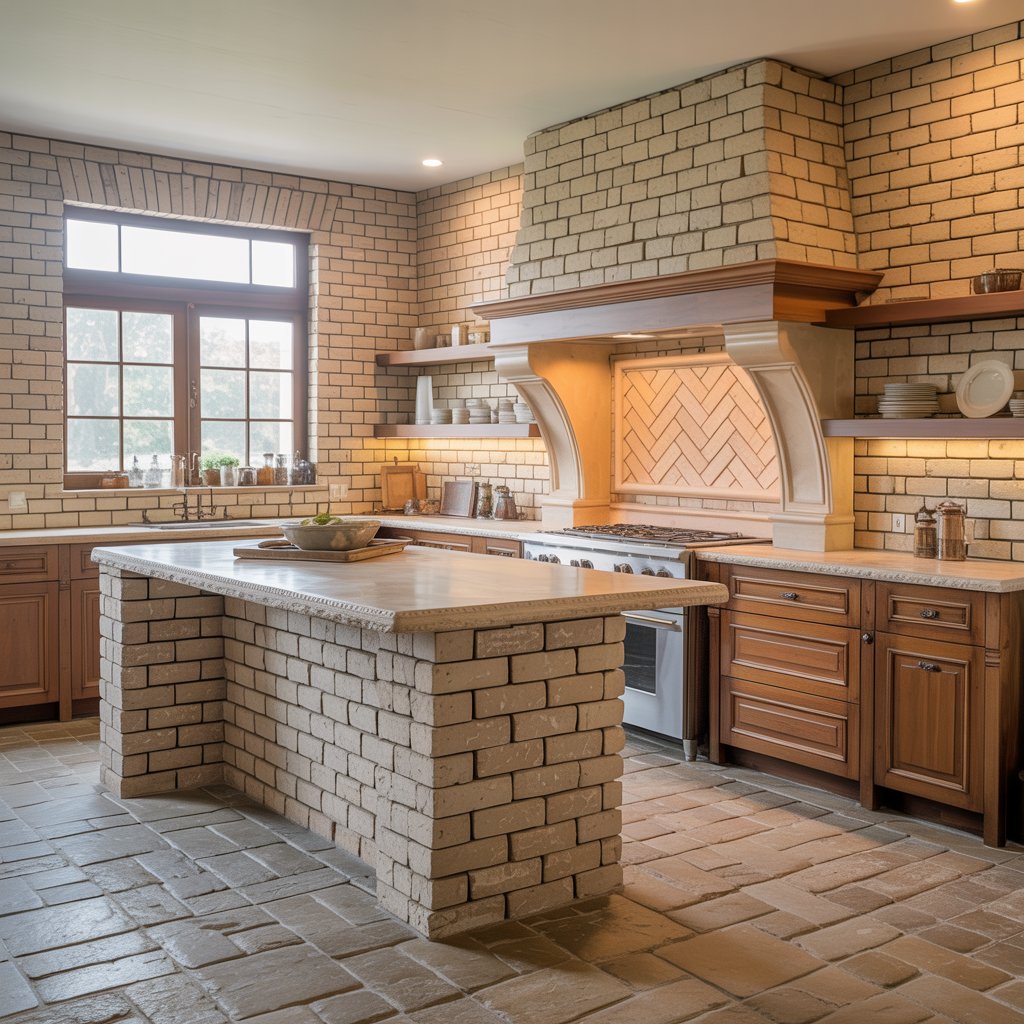
Below are the most common and most effective applications for tumbled limestone in American kitchens, each with its own design considerations and practical benefits.
- Kitchen Flooring: The most popular application. The tumbled texture provides natural slip resistance — a major plus in a busy kitchen environment — and the matte surface hides everyday dust and crumbs better than polished alternatives.
- Backsplash Tiles: Tumbled limestone in a classic brick or stacked pattern creates a stunning backsplash that bridges rustic warmth and elevated sophistication. Subway-cut tumbled limestone is especially popular right now.
- Kitchen Island Surround: Wrapping the base of a kitchen island in tumbled limestone creates an anchoring focal point that feels organic and architecturally significant.
- Range Hood Casing: One of my personal favorite design moves — framing a range hood in stacked or herringbone-laid tumbled limestone is a show-stopping detail that instantly elevates the entire kitchen.
- Window Sill and Ledge Coping: Thick tumbled limestone sills around kitchen windows add a beautiful Old World detail that’s functional and beautiful simultaneously.
- Open Shelving Backing: Tiling the back wall of open shelving areas in a contrasting tumbled limestone creates visual depth and makes displayed dishware pop dramatically.
When using tumbled limestone for your kitchen backsplash, choose a slightly smaller format tile (2″x4″ or 4″x4″) than your floor tile. This creates a natural visual rhythm — the floor reads as a grounded, stable plane while the wall feels more intricate and detailed. Mixing tile sizes across a single stone material is one of the most effective — and underused — tricks in natural stone design.
Grout Selection: The Decision That Makes or Breaks the Look
I have seen beautiful tumbled limestone installations ruined — truly ruined — by a poor grout choice. Grout is not an afterthought; it is a design decision of equal importance to the tile itself. Because tumbled limestone tiles have irregular, softened edges (that’s the whole point), they naturally have slightly wider, more organic grout joints than polished tiles, which means the grout color will have a significant visual impact on the final look.
For a seamless, flowing look that lets the stone dominate, choose a sanded grout in a tone that closely matches your lightest limestone color. For a more defined, grid-forward aesthetic that adds graphic interest, go one to two shades darker. Avoid stark white grout entirely — it creates too harsh a contrast and will age poorly with staining. A warm putty, natural sand, or driftwood grey grout is almost always the right call.
| Grout Color | Effect Achieved | Best Limestone Pairing |
|---|---|---|
| Natural Sand / Linen | Seamless, stone-forward look | French Vanilla, Turkish Beige |
| Warm Putty / Greige | Cohesive, soft definition | Jerusalem Gold, Noce |
| Driftwood Grey | Modern contrast, graphic grid | Silver Travertino, Texas Fossil |
| Charcoal / Dark Grey | Bold, high-contrast, dramatic | Pale cream varieties only |
Sealing and Maintenance: What Every Homeowner Must Know
Here is where I always have an honest conversation with my clients, because limestone is a porous natural stone that does require a bit more attention than ceramic or porcelain. Tumbled limestone, with its naturally open, textured surface, is slightly more porous than polished limestone — meaning it needs proper sealing before installation and periodic resealing to maintain its beauty and protect it from kitchen oils, acids, and moisture.
The good news? Properly sealed and maintained tumbled limestone is genuinely easy to live with. It does not show every water splash or fingerprint. The matte, textured surface actually disguises daily grime better than glossy alternatives. A good quality penetrating stone sealer applied before grouting, and once every one to two years thereafter, will keep your limestone looking stunning for a lifetime — and likely your children’s lifetimes too.
- Before installation: Apply a high-quality penetrating impregnating sealer to all tiles. Allow to cure fully per manufacturer instructions.
- Grout and cure: Allow grout to cure completely (minimum 72 hours) before sealing the entire installation again, including the grout lines.
- Daily care: Sweep or dry mop regularly. Use a pH-neutral stone cleaner — never vinegar, bleach, or citrus-based products, as acids etch limestone.
- Annual check: Perform the water bead test annually. Drop water on the surface; if it absorbs rather than beads, it’s time to reseal.
- Spot treatment: Blot spills immediately, especially citrus juices, wine, tomato sauce, and coffee. Do not rub — blot from the outside in.
Always request a sample tile from your supplier and test your chosen sealer on that sample before applying it to your floor. Some sealers can darken or slightly alter the tone of certain limestone varieties. Testing on a spare tile first — rather than discovering the color change after the fact — is one of those small steps that prevents expensive regret. My personal go-to is a penetrating, water-based impregnating sealer rated for kitchen use.
Tumbled Limestone Tile Sizes and Pattern Layouts
The format and pattern in which you lay tumbled limestone tiles can dramatically alter the feeling of your kitchen. A small, mosaic-style format in a Versailles pattern reads as artisan and antique. Large 18″x18″ squares laid in a simple grid feel more refined and modern while retaining all the warmth of the stone. Pattern is a design tool — use it intentionally.
| Tile Size / Pattern | Visual Effect | Room Size Recommendation | Style Match |
|---|---|---|---|
| 4″x4″ Grid | Cottage, intimate, traditional | Small to medium kitchens | Farmhouse, Cottage, Country |
| 12″x12″ Grid | Classic, open, balanced | Medium kitchens | Traditional, Transitional |
| 18″x18″ Grid | Expansive, refined, modern | Large open-plan kitchens | Modern Farmhouse, Transitional |
| Versailles Pattern (mixed sizes) | Old World, artisan, dynamic | Any size — most impactful in large spaces | Tuscan, Mediterranean, French Country |
| Herringbone (rectangular tiles) | Movement, visual energy, sophisticated | Backsplashes, accent areas | Eclectic, Modern Traditional |
| Running Bond / Brick Offset | Relaxed, approachable, casual | Backsplashes, smaller floors | Casual Country, Coastal, Rustic |
Design Pairings: What Goes Best with Tumbled Limestone?
As a designer, one of the questions I get asked most frequently is: “What do I pair with tumbled limestone?” The answer is both simpler and more exciting than most people expect. Because tumbled limestone is inherently warm, natural, and organic, it pairs beautifully with materials that share those qualities — and creates compelling contrast with those that lean cooler and more structured.
Here are my tried-and-tested pairings for American kitchens that balance beauty, function, and livability across different design aesthetics and budget ranges.
- White or cream Shaker cabinets: The ultimate classic pairing. The crisp cabinet lines balance the soft, organic stone texture, creating a kitchen that is both clean and warm simultaneously.
- Unlacquered brass or oil-rubbed bronze hardware: These warm metal finishes echo the golden and brown undertones in most limestone varieties, creating a cohesive, layered look.
- Honed marble or quartzite countertops: Two natural stones in complementary tones and textures is a designer’s secret weapon. Avoid polished surfaces, which can feel tonally discordant against matte limestone.
- Exposed wood beams or open-grain wood cabinetry: Limestone and timber are a timeless natural material pairing that appears in beautiful homes from Napa Valley to the Hudson Valley.
- Apron-front farmhouse sink: A fireclay or cast-iron apron sink paired with tumbled limestone flooring and backsplash is essentially the definitive American farmhouse kitchen look.
- Aged copper or rattan pendant lights: Organic material lighting fixtures reinforce the natural stone’s earthy palette without competing with it.
- Deep green or forest sage cabinetry: One of the most beautiful and currently on-trend combinations — rich botanical greens against warm stone creates a space that feels like a secret garden and a chef’s kitchen simultaneously.
“The best kitchens feel collected rather than decorated. Tumbled limestone is a perfect foundation material precisely because it looks like it chose you — not the other way around.”— Sara Whitfield, on the philosophy of natural material design
Cost Breakdown: Budgeting for a Tumbled Limestone Kitchen
One of the myths I want to address head-on is that natural stone tile is always prohibitively expensive. While premium imported varieties certainly carry a premium price tag, there is genuinely excellent tumbled limestone available at a wide range of price points. Turkish and Mexican limestone varieties in particular offer exceptional quality at accessible prices, making this look achievable for middle-budget renovations as well as luxury builds.
| Budget Category | Material Cost (per sq. ft.) | Installation Cost (per sq. ft.) | Total Estimate (200 sq. ft. kitchen) |
|---|---|---|---|
| Value / Entry-Level | $5 – $8 | $8 – $12 | $2,600 – $4,000 |
| Mid-Range | $9 – $14 | $12 – $16 | $4,200 – $6,000 |
| Premium / Imported | $15 – $22 | $16 – $24 | $6,200 – $9,200 |
Keep in mind that these estimates do not include substrate preparation, which can add cost if your subfloor needs leveling or waterproofing. Always budget an additional 10–15% overage for cuts and breakage, and request extra tile for future repairs — production batches can vary in tone between runs, making a perfect match difficult years later.
Common Mistakes to Avoid When Installing Tumbled Limestone
Over years of designing kitchens with natural stone, I’ve watched homeowners and even some contractors make avoidable mistakes that compromise the beauty of their tumbled limestone installations. Knowing what not to do is just as important as knowing the right approach, so here are the errors I consistently caution against.
- Skipping the sealer: Unsealed limestone in a kitchen is an oil and acid magnet. This is the single most common and most costly mistake. Seal before grouting, seal after grouting, and reseal yearly.
- Using bright white grout: It stains instantly in a kitchen environment and creates a harsh visual contrast that works against the natural, organic look of tumbled limestone.
- Not ordering extra tile: Always order 10–15% more than your measured square footage. Cuts waste material, and having extra tile from the same batch is invaluable for future repairs.
- Using the wrong adhesive: Limestone requires a white thinset mortar — grey thinset can bleed through and discolor lighter limestone varieties permanently.
- Forgetting expansion joints: Natural stone expands and contracts. Omitting perimeter and field expansion joints can cause cracking or tile lifting within a few years.
- Cleaning with acidic products: Vinegar and lemon-based cleaners — common DIY kitchen cleaning solutions — will etch and dull limestone irreversibly over time. Use only pH-neutral stone-specific cleaners.
🔗 Looking for inspiration? Browse the Houzz Limestone Kitchen Gallery and Architectural Digest’s Natural Stone Interiors for real-home examples across every style and budget.
Is Tumbled Limestone Right for Your Kitchen? A Quick Assessment
Tumbled limestone is a magnificent material — but it is not the right choice for every household or every lifestyle. I always encourage my clients to think honestly about how they live before committing to any natural stone. If your kitchen is the heart of daily cooking, family chaos, and constant foot traffic, limestone can absolutely handle it — but it does require a more mindful cleaning routine than porcelain. If low-maintenance is your absolute top priority, a tumbled limestone-look porcelain tile (which has improved dramatically in quality and realism) may serve you better.
That said, if you are someone who appreciates natural beauty, values materials that improve with age and character, and is willing to invest a modest amount of care in maintaining your space — tumbled limestone will reward you with a kitchen that looks more beautiful a decade from now than it does on installation day. And that, in the world of interior design, is an extraordinarily rare and precious thing.
Final Thoughts From the Design Studio
After working with countless American homeowners across every style and budget, my conviction remains unchanged: tumbled limestone tiles are one of the most enduringly beautiful, versatile, and emotionally resonant materials available for kitchen design today. They connect us to something ancient and unhurried — a counterweight to the fast-paced, disposable aesthetic that dominates so much of modern life.
Whether you choose it for your kitchen floor, your backsplash, your island surround, or all three, tumbled limestone brings an irreplaceable warmth and authenticity to the most-used room in your home. It is a material that invites lingering, encourages gathering, and makes cooking feel like the pleasure it was always meant to be. In a kitchen grounded by tumbled limestone, you are not just making dinner — you are in a space worth being in.
Ready to Transform Your Kitchen?
Get personalized design guidance, material sourcing recommendations, and a full tile specification sheet for your specific kitchen dimensions.Book a Free Design Consultation