
Kitchen Hutches: Furniture-Inspired Storage Revival
How a timeless classic is reclaiming its rightful place at the heart of the American kitchen
There is a quiet revolution happening in kitchens across America — and it does not involve a new appliance, a smart gadget, or a trendy countertop material. It involves a piece of furniture that your grandmother almost certainly owned, one that is suddenly more covetable than ever: the kitchen hutch. As a home interior designer who has helped hundreds of families reimagine their living spaces, I have watched the kitchen hutch stage one of the most satisfying comebacks in residential design. Its combination of serious storage capacity, display-worthy style, and furniture-quality craftsmanship makes it uniquely suited to the way Americans cook, entertain, and decorate.
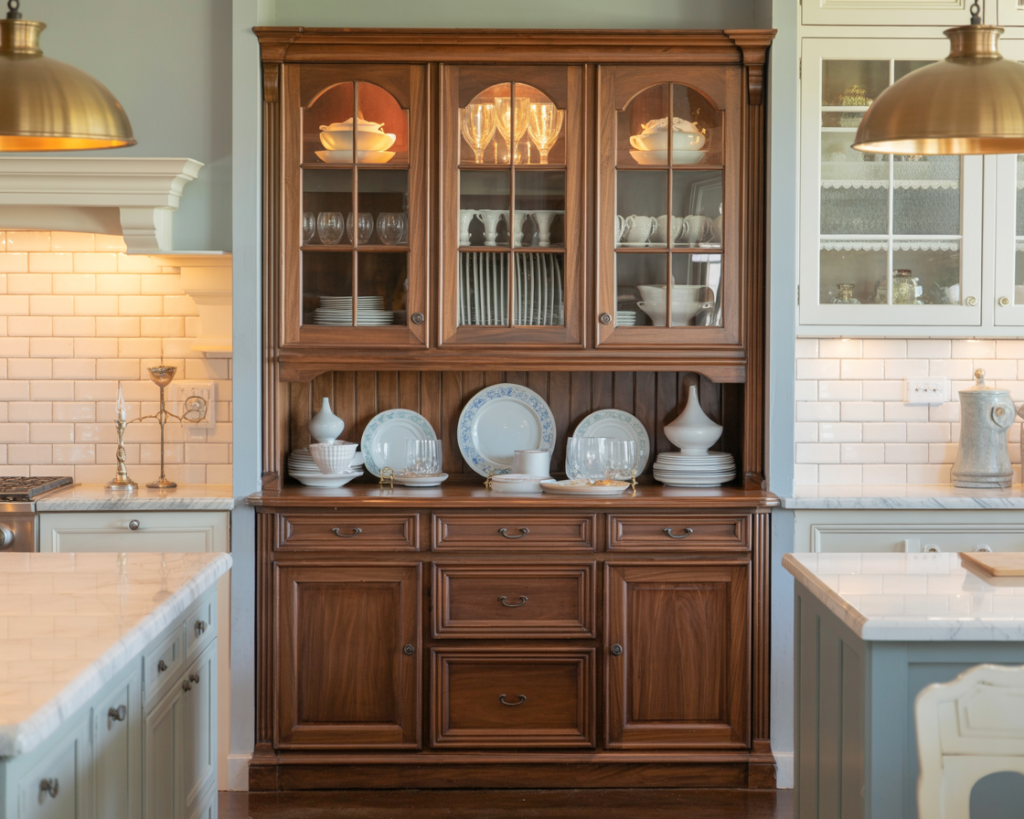
The modern kitchen hutch is not the dusty, overcrowded piece you may remember from your parents’ dining room. Today’s versions are thoughtfully proportioned, finished in everything from matte black to sage green, and designed to work as hard as any built-in cabinetry — while looking far more personal and collected. Whether you live in a compact urban apartment or a sprawling suburban home, a well-chosen hutch can solve your storage problems while becoming one of the most striking focal points in your kitchen or dining area.
What Exactly Is a Kitchen Hutch? (And Why It’s Different from a Buffet)
Before we dive deep, let’s clear up a persistent point of confusion in the world of freestanding kitchen furniture. A kitchen hutch is a two-part storage unit: a lower cabinet or credenza base — often featuring drawers, cupboard doors, or a combination of both — topped by an upper open shelving unit, which may include glass-front doors, plate rails, or cubbies for display. This stacked configuration is what sets it apart from a buffet or sideboard, which consists only of the lower cabinet base.
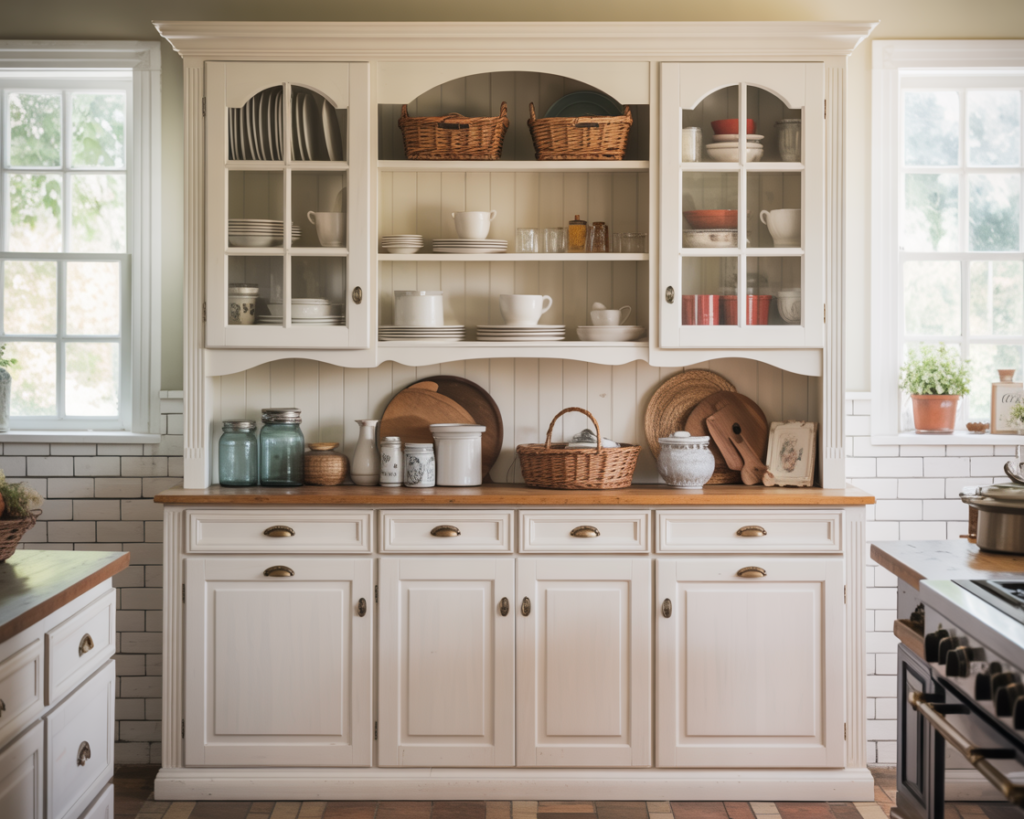
The hutch’s upper portion is its secret weapon. It creates vertical storage that draws the eye upward, making even modestly sized kitchens feel grander, while providing dedicated space for the items you want to both access easily and show off — heirloom dishware, everyday dinnerware, cookbooks, woven baskets, and decorative pieces that reflect your personality. In functional terms, a well-organized hutch is a freestanding pantry cabinet, a china cabinet alternative, and a kitchen display unit all rolled into one beautifully proportioned piece of furniture.
| Piece | Structure | Best For | Typical Width |
|---|---|---|---|
| Kitchen Hutch | Upper shelves + lower cabinet base | Display + storage, vertical impact | 36″ – 72″ |
| Buffet / Sideboard | Lower cabinet only | Serving surface, hidden storage | 42″ – 66″ |
| China Cabinet | Enclosed glass display case | Formal dishware display | 36″ – 60″ |
| Pantry Cabinet | Tall single unit, fully enclosed | Food and dry goods storage | 18″ – 36″ |
| Kitchen Island | Freestanding, accessed from all sides | Prep space, seating, storage | 36″ – 84″ |
The Design Revival: Why Kitchen Hutches Are Back in a Big Way
The decline of the kitchen hutch coincided with the rise of the fully fitted kitchen — those seamless wall-to-wall cabinetry systems that dominated American home design from the 1970s through the 2000s. Built-ins offered uniformity and maximum storage efficiency, and the freestanding hutch, with its individual character and visual weight, was gradually pushed out. It retreated to antique stores, farmhouse renovations, and the occasional grandmotherly dining room. But design, like fashion, moves in cycles, and the pendulum has now swung decisively back.
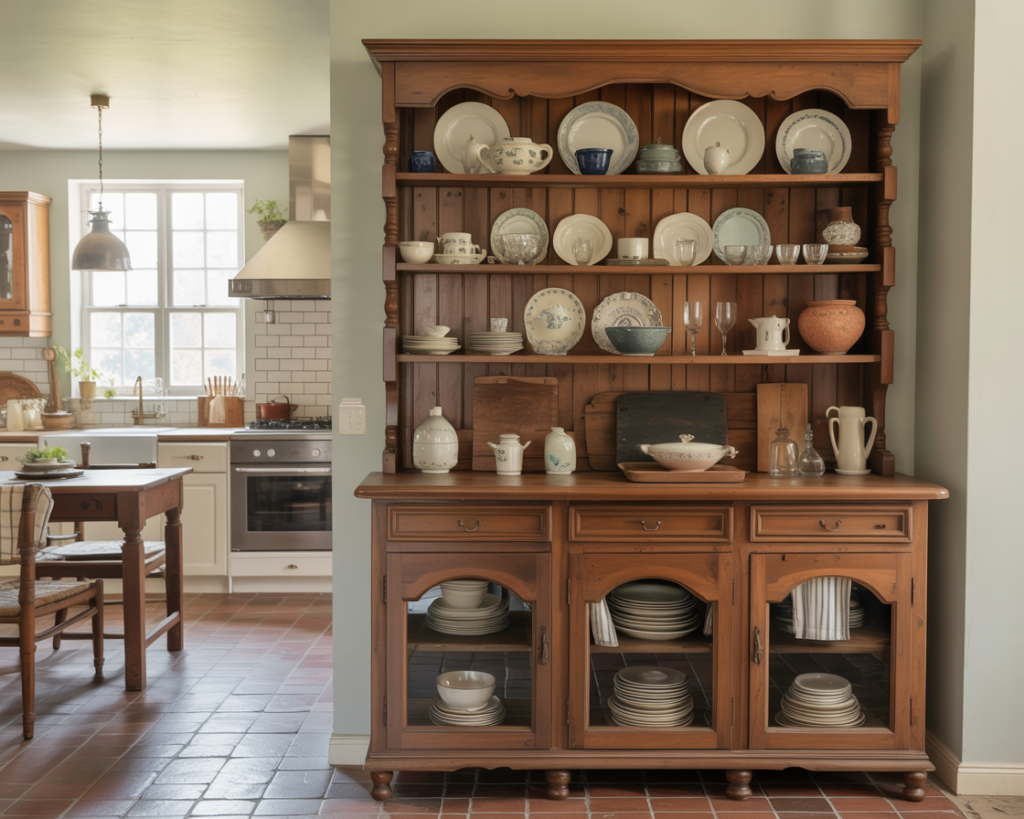
Several major cultural and design shifts are driving this revival. The rise of cottagecore aesthetics, European farmhouse interiors, and the influence of social media platforms like Pinterest and Instagram have created enormous appetite for kitchens that feel curated rather than manufactured. Homeowners are moving away from the look of showroom-perfect cabinetry and toward spaces that feel layered, lived-in, and full of personality. The kitchen hutch delivers exactly this quality. It is also a response to the growing open-plan kitchen and dining room layout, where furniture-grade pieces are needed to anchor the space and bridge the gap between cooking zone and living area.
“The best kitchens I design today tell a story. A hutch is one of the most powerful ways to do that — it holds your history, your taste, and your everyday life all in one piece.”— Interior Designer Perspective,
Popular Kitchen Hutch Styles for Every American Home
One of the great joys of working with hutches is the sheer variety of styles available. Unlike built-in cabinetry, which is largely defined by your kitchen’s existing architecture, a freestanding hutch can be chosen to complement your taste — and even evolve as your style does over the years. Here are the most popular design directions I recommend to my clients across the country.
| Style | Key Features | Best Paired With | Trending Colors (2025) |
|---|---|---|---|
| Farmhouse / Shaker | Flat-panel doors, simple hardware, open shelves | Subway tile, butcher block, apron sinks | Antique White, Warm Linen |
| Modern Cottage | Beadboard backing, turned legs, glass knobs | Floral wallpaper, rattan accents | Sage Green, Duck Egg Blue |
| Mid-Century Modern | Tapered legs, hairpin hardware, cane insets | Terrazzo floors, pendant lights | Warm Walnut, Burnt Sienna |
| Industrial / Urban | Metal frames, reclaimed wood, open shelving | Exposed brick, concrete counters | Matte Black, Raw Steel |
| Traditional / Classic | Glass-front upper doors, crown molding | Marble surfaces, formal dining sets | Deep Navy, Hunter Green |
✦ Pro Tip
When choosing a hutch color, you do not need to match your existing cabinetry exactly — in fact, I actively discourage it. A hutch in a contrasting finish (like a deep forest green against cream kitchen cabinets) reads as a deliberate, designer-intentional choice, and creates the layered, collected look that makes a kitchen feel truly personal. Think of it as an accent piece of furniture, not an extension of your built-ins. If you are unsure, test a large paint chip or order a sample door from the manufacturer before committing.
How to Choose the Right Kitchen Hutch Size and Placement
Sizing is where I see most homeowners make their biggest mistakes. The natural instinct is to choose the largest hutch that will physically fit in your space — but proportion is about visual balance, not maximum square footage. A hutch that is too wide or too tall for its wall will make the room feel crowded and chaotic, while one that is too small will look like an afterthought lost against a large expanse of wall. Before you shop, spend time measuring not just the available floor space but the ceiling height, the width of the wall, and the sightlines from adjacent rooms.
As a general rule I apply in my design practice: the hutch should occupy no more than two-thirds of the width of the wall it sits against. Allow at least 12 to 18 inches of clearance on either side to let the piece breathe visually. If your ceiling height is below 8 feet, look for hutches with a maximum height of 72 to 76 inches — going taller can feel oppressive. For ceiling heights of 9 feet and above, a taller unit with a more substantial upper display section becomes a magnificent focal point. Always consider traffic flow: in kitchen and dining areas, ensure at least 36 inches of clearance in front of the hutch for comfortable access to drawers and cabinet doors.
📐 Quick Sizing Checklist Before You Buy
- Measure the wall width — your hutch should be no more than ⅔ of this measurement
- Check ceiling height — allow 2–4 inches of clearance above the hutch’s upper section
- Measure door openings — will the hutch fit through your front door and hallways when delivered?
- Confirm depth — standard hutch depth is 14–18 inches; ensure it doesn’t block walkways
- Check for level floors — use adjustable feet or shims on uneven surfaces
- Locate wall studs — the upper hutch section must be anchored securely to a wall stud
Smart Storage Strategies: How to Organize Your Kitchen Hutch Like a Designer
A kitchen hutch is only as effective as its organization. I have styled and organized hundreds of hutches over the course of my career, and the difference between one that looks like a beautiful, curated vignette and one that looks like a cluttered closet is almost entirely a matter of intentionality. The first principle I teach my clients: every item on the open shelves of your hutch should earn its place by being either useful or beautiful — ideally both. This is not the place for random overflow from your cabinets; it is a stage for your most cherished everyday objects.
Start by dividing the hutch into zones based on frequency of use. The lower cabinet section, with its enclosed storage, is perfect for dry pantry goods, small appliances, extra linens, and anything you do not need daily visual access to. The open upper shelves should follow a deliberate layering strategy: largest and tallest items at the back (pitchers, tall vases, stacked dinner plates), medium items in the middle (mugs, bowls, glass canisters, small plants), and small decorative accents at the front (a favorite figurine, a folded linen napkin, a single candle). Aim for odd-numbered groupings — three or five items per shelf cluster almost always looks more natural and intentional than even groupings.
- Upper shelves: Everyday dishware, glassware, cookbooks, decorative objects, woven baskets, plants
- Counter surface of the base: Coffee station, bread box, fruit bowl, serving boards — keep this area functional and styled
- Drawers: Cutlery, cloth napkins, wine tools, small kitchen accessories
- Lower cabinets: Small appliances (blender, toaster), dry goods, table linens, serving pieces used occasionally
✦ Pro Tip
Use the interior back panel of your hutch’s upper section as a design feature. If it’s painted a standard white, consider adding a peel-and-stick wallpaper, a coat of deep contrasting paint, or even beadboard panels to create a “jewel box” effect. This simple upgrade — often costing under $50 — transforms the hutch from a piece of furniture into a design statement. Look for removable wallpaper options at Spoonflower or Anthropologie Home for pattern-forward options that pair beautifully with hutch shelving.
Material and Finish Guide: What to Look For When Shopping
The quality of a kitchen hutch varies enormously across the market, and knowing what to look for will save you from a disappointing purchase. At the premium end, you will find hutches crafted from solid hardwoods — oak, maple, cherry, and walnut are the most common — which offer durability, beautiful grain, and the ability to be refinished over decades. Mid-range options often combine solid wood frames with MDF (medium-density fiberboard) panels, which is entirely acceptable as long as the MDF is used in non-structural areas and the piece has solid wood drawer boxes and face frames. Be cautious of hutches that are MDF or particleboard throughout, as these tend to sag under heavy dishware and do not hold hardware well over time.
Hardware deserves more attention than most shoppers give it. Knobs and pulls are the jewelry of your hutch, and upgrading them is one of the easiest and most cost-effective ways to elevate a more affordable piece. Rejuvenation and Schoolhouse Electric offer exceptional heritage-quality hardware that can make a mid-priced hutch look custom. For finish durability in a kitchen environment — where humidity, cooking grease, and regular cleaning are factors — look for catalyzed lacquer, conversion varnish, or a hand-rubbed oil finish, all of which offer better moisture resistance than standard paint or stain.
| Material | Durability | Price Range | Best For |
|---|---|---|---|
| Solid Hardwood | ★★★★★ | $800 – $4,000+ | Heirloom quality, refinishing potential |
| Solid Wood + MDF Panels | ★★★★☆ | $400 – $1,200 | Good value, most mainstream options |
| Painted MDF | ★★★☆☆ | $200 – $600 | Budget-conscious, light-duty use |
| Metal Frame / Reclaimed Wood | ★★★★☆ | $350 – $1,500 | Industrial, loft, urban modern style |
| Antique / Vintage (restored) | ★★★★★ | $150 – $2,000+ | Character, uniqueness, sustainability |
Where to Buy: From Vintage Markets to Retailer Favorites
The best kitchen hutch for your home might be found in a place you haven’t considered yet. While major furniture retailers like Pottery Barn, Williams-Sonoma, and Ethan Allen offer reliably well-made options with good customization, some of the most beautiful and affordable hutches are found through vintage and antique channels. Estate sales, Facebook Marketplace, Chairish, and local antique centers often yield extraordinary solid-wood pieces from the mid-century era for a fraction of the cost of new furniture — and with a character and patina that no factory can replicate. A lightly restored antique hutch, given a fresh coat of paint in a trending color, can become the single most talked-about piece of furniture in your home.
For those who prefer new furniture with a conscience, a growing number of makers specialize in sustainably sourced solid wood hutches built to order. Check out CustomMade for artisan-built options, or explore IKEA’s HEMNES series for budget-friendly options that accept aftermarket hardware upgrades beautifully. Whatever your budget, I encourage every client to treat a hutch as a long-term investment — it is one of the few pieces of furniture that, if well chosen, can follow you through multiple homes and decades of changing décor trends.
“A great hutch is like a great bookshelf — it doesn’t just store things, it reveals who you are. Every plate, every teacup, every cookbook on its shelves is a sentence in your home’s autobiography.”— On the Philosophy of Intentional Interiors
Styling Your Hutch for the Seasons: A Living Design Element
One of my favorite things about working with open-shelf hutches is how easily they can be restyled to reflect the seasons and holidays — making them one of the most dynamic design elements in your entire home. Unlike built-in cabinetry, which is essentially static once installed, a hutch invites regular refreshing. In autumn, swap out the everyday white dinner plates for warm terracotta-toned ceramic dishes, add a few amber glass vessels, stack some pumpkin-hued cloth napkins, and introduce dried botanicals or fall foliage. In winter, glass hurricanes with pillar candles, vintage silver serving pieces, and evergreen sprigs transform the same hutch into a holiday vignette worthy of a magazine spread.
Spring and summer styling leans into lightness and texture: linen napkins in soft pastels, collected pottery in coastal blues and whites, a small vase of fresh flowers clipped from the garden, and woven rattan baskets replacing heavier ceramic storage pieces. This seasonal rotation does not require purchasing entirely new objects — most of my clients achieve it by rotating items already in their home, supplemented by very small purchases from thrift stores or local markets. The key is intentionality: edit ruthlessly, display generously, and let the hutch breathe between each styled layer.
🍂 Seasonal Hutch Refresh — What to Swap and When
- Spring: Pastel ceramics, linen textiles, fresh florals, light rattan baskets, botanical prints
- Summer: Coastal blues and whites, glass vessels, garden herbs, woven textures, outdoor entertaining pieces
- Autumn: Earthy terracotta, amber glass, dried botanicals, warm-toned textiles, harvest produce displays
- Winter/Holiday: Silver and gold accents, candlelight, evergreens, heirloom dishes, cozy wool textiles
Final Thoughts: Investing in a Piece That Lasts Generations
The kitchen hutch’s return to center stage in American home design is not a passing trend — it is a recognition of something timeless. In an era of disposable furniture and interchangeable aesthetics, there is a profound satisfaction in owning a piece that is rooted in craft, purpose, and beauty. A well-chosen hutch will serve you for decades: storing your everyday essentials, displaying your most cherished objects, and quietly evolving with each new season and chapter of your life.
Whether you invest in a custom solid-wood piece built to your exact specifications, discover a magnificent antique at a weekend estate sale, or transform a budget-friendly retail find with new hardware and a coat of paint, the right kitchen hutch will reward you every single day. It is, in the truest sense of the phrase, furniture-inspired storage — and it deserves its revival. If you are ready to explore your options, start by measuring your space, defining your style direction from the table above, and visiting a few local antique centers and furniture showrooms to see these pieces in person. Your kitchen is waiting for this piece — and once it arrives, you will wonder how you ever lived without it.