
Decorating Kitchens Like Living Rooms
The kitchen is no longer just a cooking zone. Learn how interior designers are blurring the lines between culinary and comfort spaces — and how you can do it at home.
By Elena Marsh, Interior Designer
In this article
- Why kitchens are becoming living spaces
- Choosing furniture that bridges both worlds
- The power of textiles and soft furnishings
- Layered lighting like a pro
- Bringing art and personality into the kitchen
- Plants, greenery, and organic elements
- Common mistakes to avoid
Forget everything you thought you knew about kitchen design. The most beautiful, livable kitchens in America right now look less like sterile cooking labs and more like the coziest room in the house.
As a home decor specialist who has worked with hundreds of clients across the U.S., I’ve watched a quiet revolution unfold. Homeowners are no longer satisfied with kitchens that are purely functional. They want warmth. They want conversation. They want a space that invites you to linger over your morning coffee, host a Sunday brunch crowd, or simply feel at home. And they’re achieving it by borrowing the most powerful design principles from the living room.
This trend — often called kitchen-living integration or social kitchen design — is reshaping open-plan homes from coast to coast. Whether you have a spacious open-concept layout or a compact galley kitchen, the strategies in this guide will help you create a kitchen that feels as welcoming and beautiful as any other room in your home.Why the Kitchen Has Become America’s Living Room
The modern American home has shifted dramatically over the past decade. Open-concept floor plans eliminated the walls that once separated cooking from living, and the pandemic accelerated this evolution even further — suddenly, the kitchen was where we worked, schooled our children, cooked, and unwound, all in the same day.
Today’s kitchen is a multifunctional social hub. It’s where homework gets done at the island, where friends gather with wine glasses while the pasta boils, and where families congregate on Saturday mornings. Designing it with the same intentionality as a living room isn’t just an aesthetic choice — it’s a response to how we actually live. Understanding residential interior design psychology reveals that spaces designed for comfort encourage longer, more meaningful interactions.
Design research consistently shows that people spend more quality time together in kitchens than in any other room. That means the kitchen deserves the same curated, layered, personality-driven design approach we’ve always applied to our living rooms. It’s time to treat it that way.
Pro Tip
Before you start redecorating, map out how your household actually uses the kitchen throughout the day. Are there peak “living room” moments — homework time, morning coffee, evening wine? Design your seating, lighting, and decor around those anchors first.
Choosing Furniture That Bridges Both Worlds
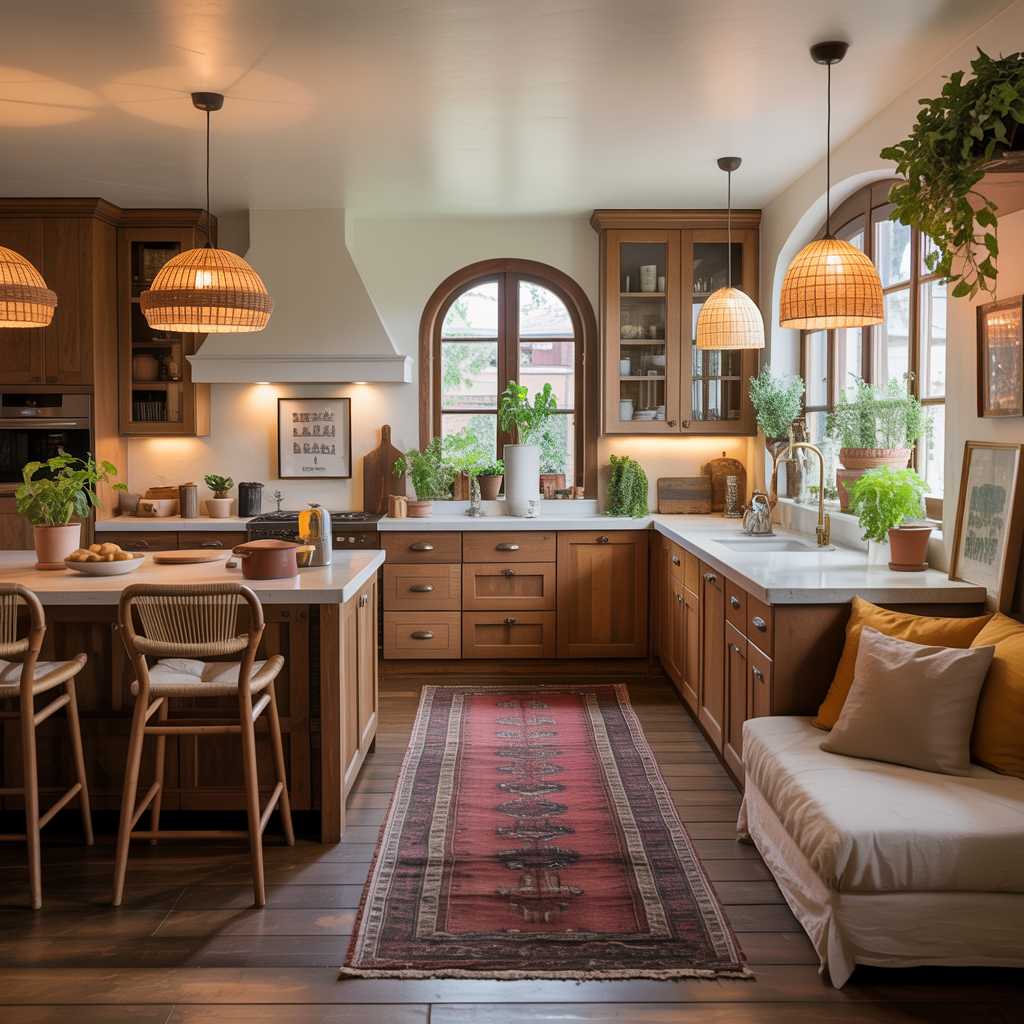
The fastest way to make a kitchen feel like a living space is to introduce furniture that doesn’t belong to traditional kitchen vocabulary. Swap out standard barstools for something with more character. Consider a cushioned banquette in a corner nook, a pair of upholstered counter stools with tapered legs, or even a vintage wooden bench tucked against a wall. These pieces signal immediately that this room is for living, not just cooking.

Kitchen islands present the best opportunity to blur this boundary. Rather than treating the island as purely utilitarian, style it like you would a sideboard — with a small table lamp, a curated stack of cookbooks, a ceramic bowl, or a sculptural vase. The kitchen island as a social focal point is one of the most powerful ideas in contemporary home design. When your island looks like it belongs in both a kitchen and a living room, the whole space feels more intentional and cohesive.
| Living Room Element | Kitchen Equivalent | Design Impact |
|---|---|---|
| Sofa / Armchair | Banquette seating or upholstered bench | Adds comfort, encourages lingering |
| Coffee table | Styled kitchen island | Creates a social anchor point |
| Side table | Rolling bar cart or butcher block trolley | Flexible, functional, decorative |
| Bookcase / shelving | Open kitchen shelving | Personalizes the space, shows character |
| Area rug | Kitchen runner or washable area rug | Defines zones, adds warmth underfoot |
| Table lamp | Cordless table lamp on island or counter | Ambient lighting, instant coziness |
Pro Tip
Don’t be afraid of a washable area rug in your kitchen. Brands like Ruggable and Lorena Canals make beautiful, machine-washable options that add that unmistakable living-room warmth without the practical nightmare. A runner in front of the sink or a 5×7 under a kitchen table changes the entire feel of the room.
“The kitchens I’m most proud of don’t look like kitchens at all — they look like the most beautiful room in the house, that also happens to have a stove.”
The Power of Textiles and Soft Furnishings
Nothing transforms a kitchen faster or more affordably than textiles. Living rooms are defined by their softness — throw pillows, drapes, plush rugs, cozy blankets — and yet most American kitchens have zero soft furnishings beyond a dish towel. Closing that gap is one of the highest-impact moves you can make in kitchen interior styling.

Start with window treatments. Kitchen windows are almost always dressed in stark, practical blinds — but linen Roman shades, lightweight curtain panels, or even woven bamboo shades instantly warm the space and add that “designed” quality that living rooms have. Choose fabric in a natural, muted palette: warm white linen, aged ivory, soft sage, or dusty terracotta. These earthy, organic tones work beautifully in kitchens and complement most cabinetry colors. Layer a decorative cushion or two on your banquette or window seat, and suddenly your kitchen has texture, depth, and soul.
- Linen curtain panels — Lightweight and airy; perfect for kitchens that get morning light
- Woven jute or sisal runner — Adds natural texture without being precious
- Bar stool cushions — Elevate hardwood or metal stools with an upholstered seat
- Roman shades in textured fabric — Clean, tailored look with warmth
- Linen dish towels displayed on a hook — Functional and decorative at once
- Throw or knit blanket on a bench — A living room staple that works beautifully in a breakfast nook
Layered Lighting Like a Pro
Here is where so many kitchen renovations fall short: lighting. A typical kitchen has one overhead fixture (often recessed cans or a lone pendant) and relies entirely on it for all tasks. Living rooms, by contrast, are lit in layers — ambient overhead light, accent lamps, reading lights, candles — and this layering is exactly what makes them feel so inviting and warm. Bringing layered kitchen lighting into your space is perhaps the single most transformative change you can make.

Start with ambient lighting at the overhead level, ideally with a dimmer switch. Then add a pair of pendants over the island that are more decorative than utilitarian — think rattan, aged brass, or hand-blown glass rather than industrial steel. Next, bring in table-level light: a cordless rechargeable lamp on the counter or island, or wall sconces flanking a range hood. Finally, don’t overlook under-cabinet LED strips on a warm (2700K) color temperature — they mimic the glow of candles and make the whole kitchen feel like evening in a Parisian bistro.
| Lighting Layer | Kitchen Application | Warmth Level |
|---|---|---|
| Ambient | Dimmable recessed lighting or flush mount | Medium — functional base layer |
| Task | Under-cabinet LEDs (2700K warm white) | High — warm, intimate glow |
| Accent / focal | Statement pendants over island | Very high — visual anchor, conversation piece |
| Decorative | Cordless table lamp on counter | Highest — pure living-room energy |
Pro Tip
Install a smart dimmer switch (Lutron Caseta is a reliable, widely available option) on your overhead kitchen lights. Being able to drop the brightness from 100% to 30% for a dinner party costs under $60 and will make your kitchen feel like an entirely different — and infinitely more romantic — space.
Bringing Art and Personality Into the Kitchen
Living rooms get gallery walls, framed prints, sculptural objects, and curated collections. Kitchens get a chalkboard and a clock. It’s time to end this inequity. Art in the kitchen is one of the most underused design moves available to American homeowners, and when done well, it completely reframes how the space feels and how you feel inside it.
You don’t need to hang museum-quality pieces in a room with cooking fumes. Opt instead for framed vintage botanical prints, a simple abstract in earthy tones, a collection of antique plates arranged artfully on a wall, or even a floating shelf styled with small sculptural objects — a ceramic hand, a carved wood bowl, a terracotta vase. These elements bring the same sense of curation and identity that make living rooms feel personal. The key is intentionality: every decorative object should feel chosen, not accidental. This is the heart of curated kitchen styling.
🖼
Vintage Botanical Prints
Frameable, affordable, and timeless. Look for unframed prints on Etsy and frame in simple black or natural wood.
🏺
Sculptural Ceramics
A handmade vase or jug on open shelving reads as art. Shop small ceramic artists on Etsy for unique pieces.
📚
Styled Cookbooks
Spine-out on open shelves, or stacked horizontally as a riser for a decorative object — cookbooks are both useful and beautiful.
🪞
Antique Mirror or Plate Wall
A vintage mirror reflects light and adds elegance. A curated collection of antique plates is timeless Americana.
Plants, Greenery, and Organic Elements
Living rooms with plants feel alive. They breathe, they grow, they signal care and intention. And yet most American kitchens have at best a wilting herb pot on a windowsill. Bringing in a considered kitchen plant arrangement — matching the scale and placement you’d use in a living room — transforms the sensory experience of the space completely.
Consider a tall fiddle leaf fig or olive tree in a corner near a window. Add a trailing pothos or hoya on top of open cabinets so the vines cascade down dramatically. Group three or four smaller plants of varying heights on a butcher block shelf. Choose pots and planters that align with your overall kitchen palette — terracotta for a warm Mediterranean feel, white ceramics for a clean Scandinavian aesthetic, dark matte black for a modern dramatic look. Plants are the most natural bridge between interior and exterior, between kitchen and living room, between function and beauty. Better Homes & Gardens has a great guide on the best plants for kitchens, organized by light level and humidity tolerance.
Best Plants for Kitchen Environments
- Pothos — thrives in low light, trails beautifully from high shelves
- Herbs (basil, rosemary, thyme) — functional and fragrant on the windowsill
- Snake plant — tolerates low light and humidity fluctuations
- Peace lily — loves the warmth of kitchens, elegant white blooms
- Air plants — no soil needed, display on a marble tile or in a glass globe
- Olive tree — the statement plant of the moment; Mediterranean and sculptural
Common Mistakes to Avoid When Decorating Your Kitchen Like a Living Room
The biggest mistake I see homeowners make is adding living room elements without considering the kitchen’s unique demands. Humidity, heat, cooking grease, and heavy foot traffic mean that not every fabric, finish, or material that works in a living room will hold up in a kitchen. Velvet cushions and delicate paper-shaded lamps, for example, will deteriorate quickly. Always choose materials rated for durability — performance fabrics, wipeable surfaces, and washable rugs are non-negotiable in a functional kitchen.
The second most common mistake is overdoing it. Living rooms get layered slowly over years of accumulated objects and art. When you try to apply that same richness to a kitchen all at once, it can quickly feel cluttered and overwhelming rather than curated and warm. Start with one or two living-room moves — a statement pendant, a rug, open shelving — and let the space breathe. Intentional kitchen decor means every element earns its place. Edit ruthlessly. The restraint is what makes it feel designed, not decorated.
- Using fabrics that can’t handle humidity or wipe-cleaning
- Overcrowding countertops in the name of “styling”
- Ignoring the lighting — adding decor without changing the light quality
- Choosing a rug that isn’t washable or low-pile for easy cleaning
- Forgetting to anchor the space with a defined color palette first
- Adding art or objects that clash with the cabinetry hardware finish
Pro Tip
Before buying a single decor item, pull all your cabinetry hardware, countertop samples, and appliance finishes into one photo. Use that as your reference palette for every decorative purchase. Cohesion comes from repetition — repeat one metal tone, one wood tone, and one accent color throughout the space.
“The kitchen you love to cook in and the kitchen you love to live in are the same kitchen — you just have to design for both at once.”
Your Kitchen, Reimagined
Decorating a kitchen like a living room isn’t about ignoring function — it’s about honoring the full life that happens in that space. It’s about recognizing that the room where you make your family’s meals deserves the same beauty, warmth, and personality as the room where you rest and reconnect. When those two ideas merge, something extraordinary happens: your home starts to feel genuinely cohesive, and your kitchen becomes the room everyone gravitates toward.
Start small. Change your light bulbs to warm 2700K LEDs and install a dimmer. Roll out a washable rug. Hang one meaningful piece of art. Style your open shelving like you’d style a bookcase. Add one plant that’s bigger than you think you need. These are affordable, reversible, weekend-level changes that shift the energy of a kitchen completely. You don’t need a renovation to make your kitchen feel like the most beautiful room in your home — you just need a new perspective and a willingness to treat it like it deserves.
For more inspiration, explore resources like Architectural Digest’s kitchen design section and Houzz’s kitchen photo gallery, where you’ll find real American homes that have made this design leap beautifully.
Kitchen decor Open concept kitchen design ideas Home staging Interior design tips Kitchen remodel Cozy kitchen styling.