
Transform your open-concept space with nature’s most versatile design element — and the timeless warmth only wood can bring.
By a Certified Interior Designer · Living Room Design
If you’ve been scrolling through Pinterest or flipping through home design magazines lately, you’ve probably noticed one element appearing in virtually every stunning open-plan living room: warm wood slats. As an interior designer who has worked with hundreds of American homeowners from Brooklyn lofts to California ranch homes, I can tell you this isn’t just a passing trend. Wood slat walls, ceilings, room dividers, and accent panels have become the single most powerful tool in my open-concept design toolkit — and for very good reason.
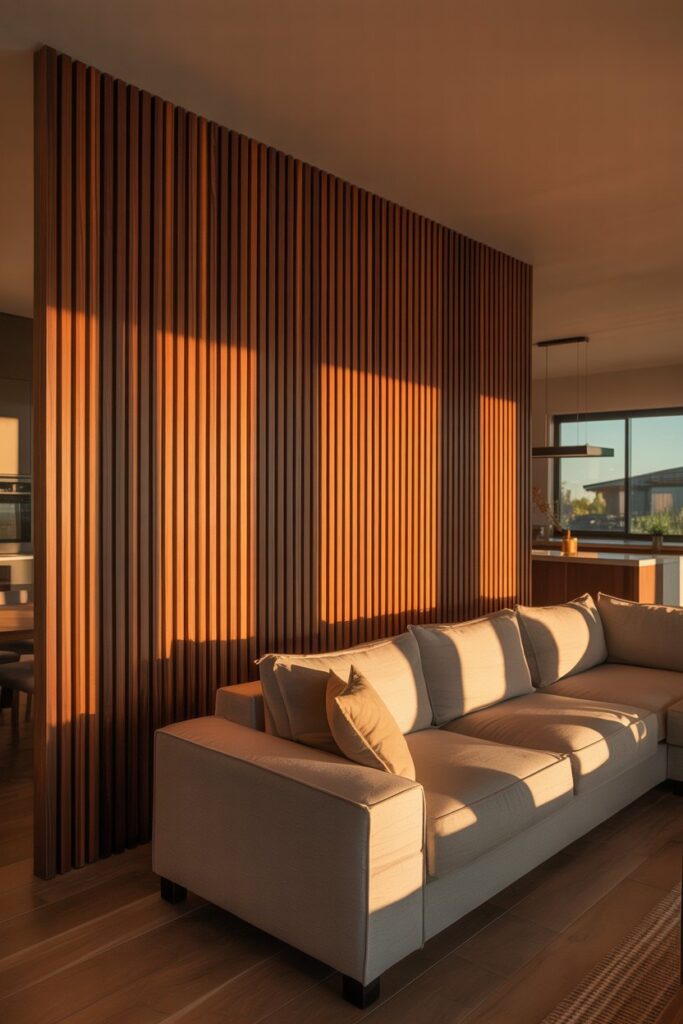
Open-plan living rooms are beautiful in theory — expansive, airy, and perfect for modern family life. But without visual anchors and thoughtful zoning, they can quickly start to feel cold, undefined, and acoustically chaotic. Warm wood slats solve all of these problems at once, bringing organic texture, natural tones, and a sense of architectural rhythm that open spaces desperately need.
In this guide, I’m going to walk you through everything you need to know about incorporating warm wood slats into your open-plan living room — from choosing the right wood species and finish to understanding how to use slats for zoning, acoustics, and visual warmth. Whether you’re doing a full renovation or just looking for a weekend DIY accent wall, this is your complete playbook.
Why Wood Slats Work So Well in Open-Plan Spaces
Open-concept floor plans became the gold standard of American home design over the past two decades — and for all the right reasons. They encourage togetherness, allow natural light to flow freely, and make even modest square footage feel generous. But interior designers have long known that truly great open-plan spaces require more than just knocking down walls. They need visual layering, acoustic treatment, and thoughtful delineation of zones.
Wood slats — sometimes called timber battens, slatted wood panels, or wood louvers depending on their application — introduce a repeating linear pattern that naturally draws the eye and creates movement within a large space. Their narrow, rhythmic profile adds architectural detail without visually cluttering the room, a balance that’s extremely hard to achieve with other materials. The warmth of natural wood grain also counterbalances the cool, hard surfaces that often dominate open-concept rooms: concrete floors, stainless steel kitchens, and large glass windows.
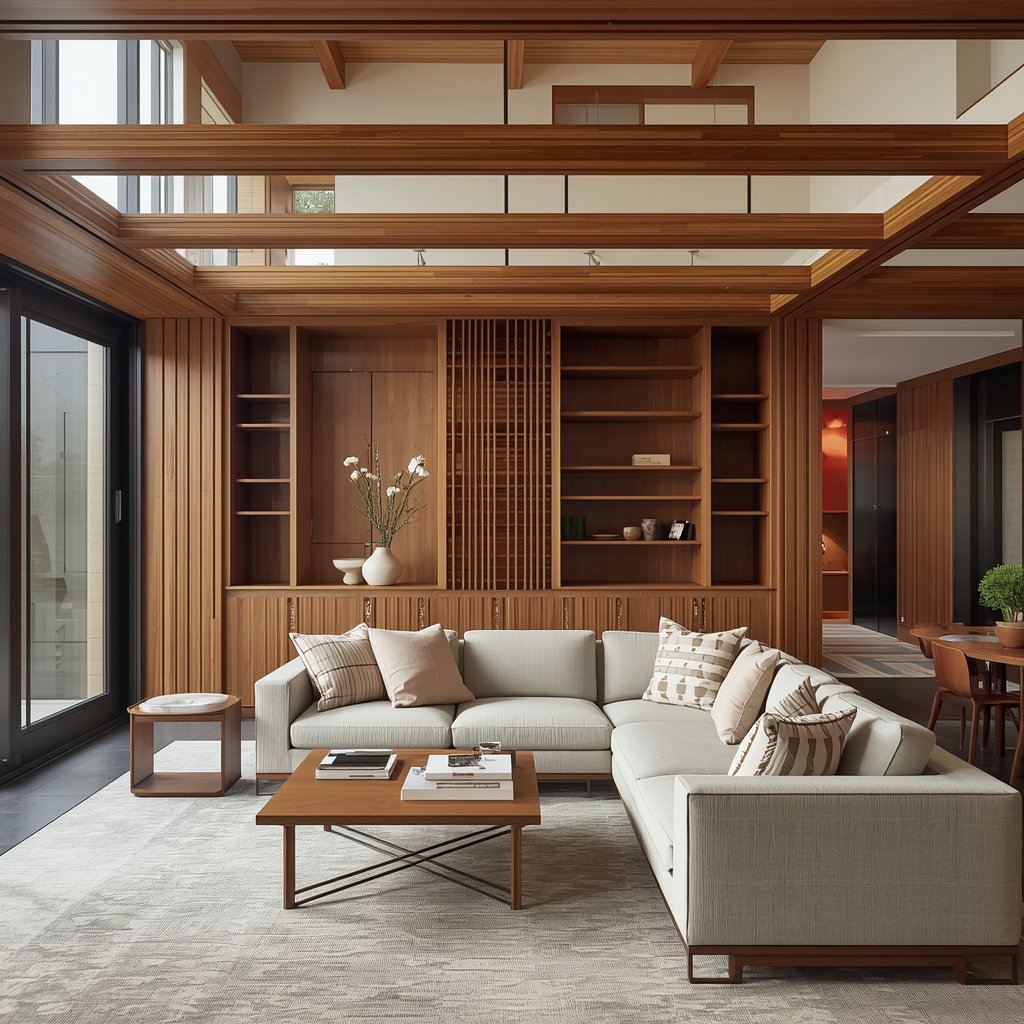
From a design psychology standpoint, organic materials like wood slats help create what researchers call biophilic connection — a subconscious sense of calm and comfort that comes from natural textures and tones. In an open-plan living room, where the absence of walls can sometimes feel disorienting, this biophilic warmth is genuinely grounding. Homeowners consistently report that rooms with wood slat features feel “cozier” and “more intentional” — even when the square footage hasn’t changed at all.
“Wood slats are the equivalent of adding punctuation to a sentence — they give an open space rhythm, pause, and meaning. Without them, a big room is just a room. With them, it becomes an experience.”— Interior Design Perspective, Open-Concept Living
The Best Wood Species and Finishes for Living Rooms
Not all wood is created equal when it comes to interior applications, and the species you choose will dramatically influence the mood and maintenance requirements of your space. Over years of specifying materials for clients, I’ve developed strong opinions about which woods deliver the best results for American living rooms — both aesthetically and practically.
The finish you apply is just as important as the species you select. A natural oil finish will enhance the grain and develop a rich patina over time, while a matte lacquer offers more protection with a cleaner, more contemporary look. Avoid high-gloss finishes on slats — they reflect light in ways that emphasize imperfections and feel out of place in residential settings. Warm white-washed or cerused finishes are particularly popular right now for homeowners who want the texture of wood without a heavy, dark tone.
| Wood Species | Tone & Grain | Best For | Durability | Price Range |
|---|---|---|---|---|
| White Oak | Light golden, tight grain | Scandinavian, transitional, modern farmhouse | Excellent | $$$ |
| Walnut | Rich chocolate, dramatic grain | Mid-century modern, luxury, moody interiors | Excellent | $$$$ |
| Cedar | Reddish-pink, aromatic | Rustic, cabin, spa-inspired spaces | Good | $$ |
| Pine | Pale cream, knotty texture | Farmhouse, budget-friendly DIY projects | Moderate | $ |
| Teak | Golden brown, oily texture | Tropical, coastal, high-moisture areas | Superior | $$$$ |
| Bamboo | Light, uniform, contemporary | Eco-conscious, minimalist, modern Asian-inspired | Very Good | $$ |
✦ Pro Tip
When selecting wood for an open-plan living room, always bring a full-length sample (at least 24 inches) into your actual space and observe it at different times of day. Morning light and evening lamp light will render the same wood completely differently — and what looks golden and warm in the showroom can appear orange or flat in your specific lighting conditions. I always recommend testing before committing to large quantities.
How to Use Wood Slats for Spatial Zoning Without Walls
One of the most common challenges my clients face in open-plan living rooms is the lack of defined zones. The kitchen bleeds into the dining area, which bleeds into the living space, and everything starts to feel like one undifferentiated room. Traditional solutions — area rugs, furniture arrangement, lighting — help, but wood slat partitions are genuinely the most elegant and architecturally sophisticated approach to open-plan zoning available today.
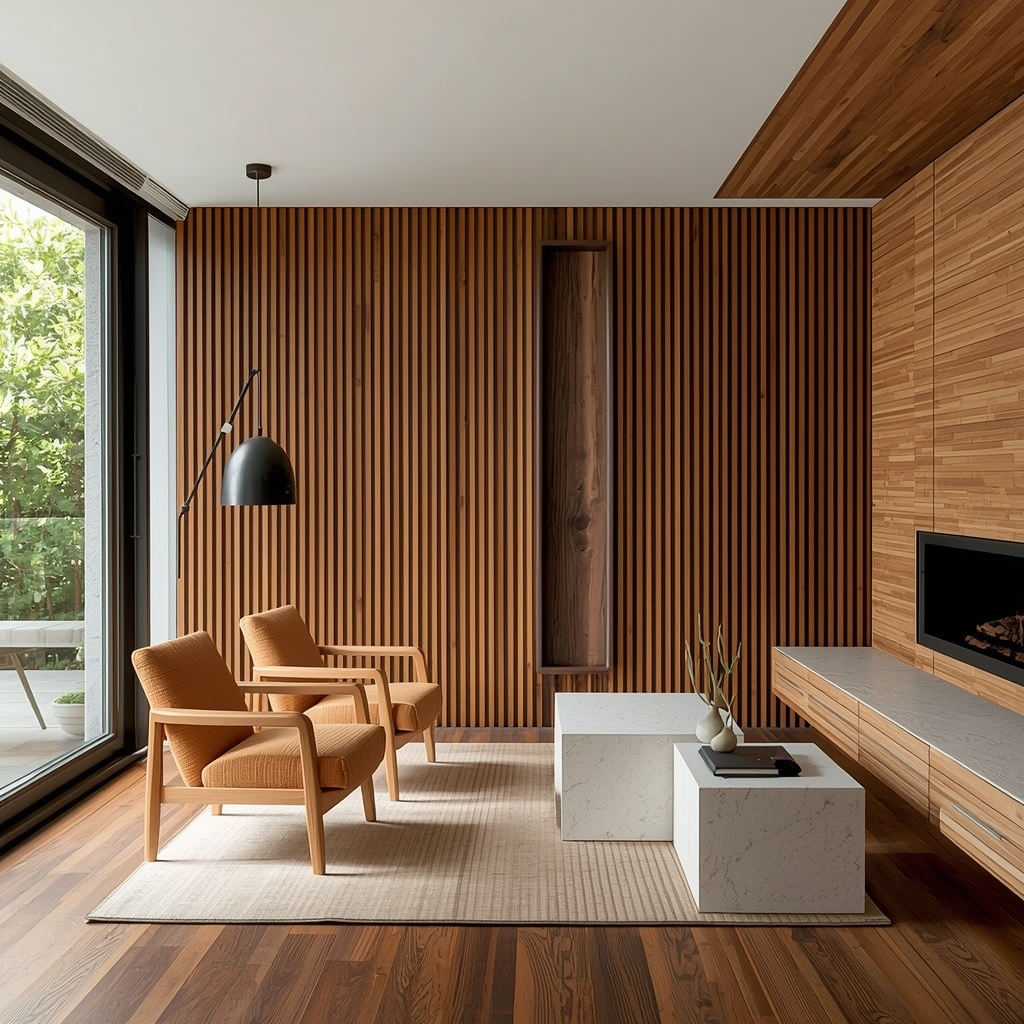
A slatted wood room divider or partial partition wall creates visual separation without sacrificing the open, airy quality that makes an open-plan layout desirable in the first place. Because slats are open by nature, light and sightlines pass between them — you maintain connection and flow between spaces while still establishing distinct territories. This is a genuinely clever solution that standard drywall walls simply cannot achieve. I’ve used this technique to carve out home offices, reading nooks, and formal dining areas within large open spaces, and the results are consistently stunning.
🏠 Zoning Applications
- Living room / dining room divider
- Entry foyer partition from main living space
- Home office nook in open plan
- TV accent wall to anchor seating zone
- Staircase screen or railing infill
- Kitchen peninsula back panel
📐 Slat Spacing Guide
- 1–2 inch gap: Maximum privacy
- 2–3 inch gap: Balanced separation
- 3–4 inch gap: Light, airy partition
- 4+ inch gap: Decorative accent only
- Angled slats: Directional privacy
- Mixed widths: Visual interest
Wood Slat Accent Walls: Placement, Proportion, and Execution
An accent wall done right can transform a living room; done wrong, it can make the space feel unbalanced and dated. Wood slat accent walls have an advantage over painted feature walls or wallpaper because the texture gives them three-dimensional presence — they read as an architectural element rather than surface decoration. The key is getting the placement and proportion right from the start.
In an open-plan living room, the ideal location for a wood slat feature wall is typically the wall behind the primary seating area — what designers call the “anchor wall.” This placement establishes the living zone as distinct from the kitchen or dining area, gives the eye a clear focal point, and makes the sofa arrangement feel intentional and grounded. Floor-to-ceiling slat installations make the biggest impact and are worth the investment; half-height or wainscoting-style slat panels can work beautifully too, but they need to be precisely proportioned to avoid looking like an afterthought.
⬛ Vertical vs. Horizontal Slat Orientation
Vertical slats make ceilings appear taller and work beautifully in rooms with standard 8–9 foot ceilings. They draw the eye upward and add elegance. Horizontal slats make walls appear wider — ideal for narrow rooms or spaces where you want to emphasize breadth. Diagonal slat applications are more avant-garde and work best in contemporary or loft-style spaces where bold visual statements are the goal. When in doubt, go vertical: it’s the most universally flattering orientation for residential living rooms.
Acoustic Benefits of Wood Slats in Open Living Spaces
Here’s a benefit that most homeowners never consider until they’ve lived with hard surfaces in an open-plan home: acoustics. Open-concept rooms with hard floors, high ceilings, and minimal soft furnishings can become echo chambers — every conversation, kitchen sound, and television program reverberates throughout the space. It’s one of the most common complaints I hear from clients who moved into brand-new open-plan homes. Wood slats, particularly when installed with acoustic insulation or sound-absorbing backing material, can make a significant difference.
The irregular surface created by slatted wood panels disrupts sound waves and reduces echo and reverberation in a way that flat surfaces simply cannot. For optimal acoustic performance, specify slats with a sound-absorbing felt or acoustic foam backing — many pre-made slatted wood panel systems now come with this integrated. The improvement in sound quality can be remarkable, particularly in rooms with concrete floors or vaulted ceilings. I often tell clients that installing a full wood slat accent wall can feel like adding a layer of acoustic insulation to their living room.
- 1 Felt-Backed Slat PanelsAvailable pre-made in oak, walnut, and pine. Easy DIY installation; excellent mid-frequency sound absorption for TV rooms and conversation areas.
- 2 Acoustic Foam + Wood FrameCustom installation with acoustic foam cavity behind slat frame. Maximum sound control; ideal for home theater zones within open plans.
- 3 Mineral Wool Batt BackingHighest-performing acoustic solution. Often used in commercial projects but increasingly requested for luxury residential open-plan spaces.
- 4 Ceiling Slat BafflesFloating wood slat panels hung from open-plan ceilings. Dramatic visual impact and excellent overhead echo control — a signature move in my high-end projects.
Styling Wood Slats: Color Palettes, Lighting, and Companion Materials
Wood slats don’t exist in isolation — how you style the elements around them determines whether the final result looks curated and professional or confused and overdone. As a designer, I approach wood slat styling as a careful balancing act between warmth and restraint, texture and simplicity. The wood itself provides so much visual interest that the surrounding palette needs to be calm and complementary rather than competing.
The most successful color palettes I’ve used alongside warm wood slats include soft whites and creamy off-whites (never bright, stark white — it fights with the warmth of wood), warm greys and greige tones, deep charcoals and near-blacks for drama, terracotta and clay for a southwestern or organic modern look, and sage greens for a nature-inspired, biophilic aesthetic. For lighting, warm-toned bulbs in the 2700–3000K range are essential — cool-white lighting will neutralize the warm undertones of the wood and make your beautiful oak or walnut slats look flat and lifeless.
✦ Pro Tip
Install LED strip lighting behind or below your wood slat panels for an effect that photographs beautifully and creates extraordinary ambiance at night. Use a warm white (2700K) LED strip on a dimmer — the light filtering through the slats creates dramatic shadows and highlights the natural grain in a way that no overhead fixture can replicate. This is one of my most-requested finishing touches and it costs less than $100 in materials for a standard accent wall.
DIY vs. Professional Installation: What You Need to Know
One of the things I love most about wood slats as a design element is that they’re genuinely accessible — you don’t need a full renovation budget or a team of contractors to incorporate them into your home. Pre-made slatted wood wall panels, available from retailers like Home Depot, IKEA, and specialty online sources, have made it possible for motivated homeowners to install a stunning accent wall over a weekend. That said, there are situations where professional installation is genuinely worth the investment.
DIY installation is completely viable for standard accent walls using pre-made panels, provided you have basic carpentry skills, a level, and a nail gun or adhesive. Custom full-room installations — slat ceilings, structural partitions, or curved applications — should be handled by a professional carpenter. The difference in finish quality between an experienced craftsperson and an ambitious beginner can be significant, particularly in terms of consistent gap spacing, precise cuts around outlets and trim, and a truly plumb installation. If you’re investing in premium wood like walnut or white oak, I strongly recommend professional installation to protect that investment.
| Project Type | DIY Friendly? | Approx. Cost (DIY) | Approx. Cost (Pro) | Time Required |
|---|---|---|---|---|
| Pre-made panel accent wall | ✓ Yes | $300–$800 | $800–$1,800 | 1–2 days |
| Custom slat feature wall | ⚡ Intermediate | $600–$1,500 | $2,000–$4,500 | 2–4 days |
| Slatted room divider / partition | ⚡ Intermediate | $500–$1,200 | $1,800–$5,000 | 2–3 days |
| Ceiling slat installation | ✗ Pro recommended | N/A | $3,000–$10,000+ | 3–7 days |
| Full-room slat surround | ✗ Professional | N/A | $8,000–$25,000+ | 1–3 weeks |
Maintenance, Care, and Long-Term Durability
A common concern I hear from clients considering wood slats is maintenance — specifically, how difficult the slats are to clean given that dust and debris can accumulate in the gaps between individual pieces. The good news is that with the right finish and a simple care routine, wood slat walls are genuinely low-maintenance and incredibly durable. In fifteen years of designing with wood slats, I’ve never had a client come back to tell me they regretted the choice based on upkeep.
Regular maintenance is straightforward: a soft-bristled vacuum attachment or compressed air can is all you need to remove dust from the slat gaps every few weeks. For deeper cleaning, a barely-damp microfiber cloth wiped along the grain works perfectly. Avoid saturating wood with water or using chemical cleaners — a simple mixture of mild dish soap diluted in warm water, applied sparingly and dried immediately, handles any actual grime effectively. Sealed or lacquered slats are more forgiving; oiled finishes will benefit from a re-oiling once a year to maintain their depth and luster. With proper care, quality wood slats should last thirty years or more without showing their age.
🧹 Quick Care Checklist
- Dust slats monthly with a soft brush vacuum attachment or microfiber duster
- Avoid direct prolonged sunlight to prevent uneven fading — use UV-filtering window film or curtains
- Re-oil natural oil-finished slats once annually with the manufacturer’s recommended product
- Address spills immediately by blotting — never rubbing — with a clean dry cloth
- Maintain indoor humidity between 35–55% to prevent wood from cracking or warping
- Inspect mounting hardware annually for any signs of loosening, especially in high-humidity climates
Final Thoughts: Making Wood Slats Work for Your Home
After years of designing open-plan living rooms across every style and budget imaginable, I keep coming back to warm wood slats as my single most reliable design recommendation. They add warmth without weight, texture without clutter, and architectural interest without construction chaos. In an open-plan space that needs anchoring, definition, and a sense of deliberate design, slatted wood delivers on every level.
The best part? You don’t need to go all-in from day one. Start with a single accent wall behind your sofa, see how the material transforms your space, and build from there. Choose a wood species that speaks to your personal aesthetic — whether that’s the blonde simplicity of white oak, the drama of dark walnut, or the earthy approachability of pine — and commit to a finish that will age beautifully in your specific lighting conditions. Take your time sourcing quality materials, consider the acoustic benefits alongside the visual ones, and don’t overlook the transformative power of warm LED lighting behind or beneath your slats.
Open-plan living rooms are one of the great joys of modern home design — but they need thoughtful layers of texture, warmth, and architectural detail to feel truly complete. Warm wood slats are, in my professional opinion, the most elegant way to provide all three at once.
“Good design isn’t about filling space — it’s about giving space meaning. Wood slats do exactly that, one beautiful vertical line at a time.”— Interior Designer’s Design Philosophy